

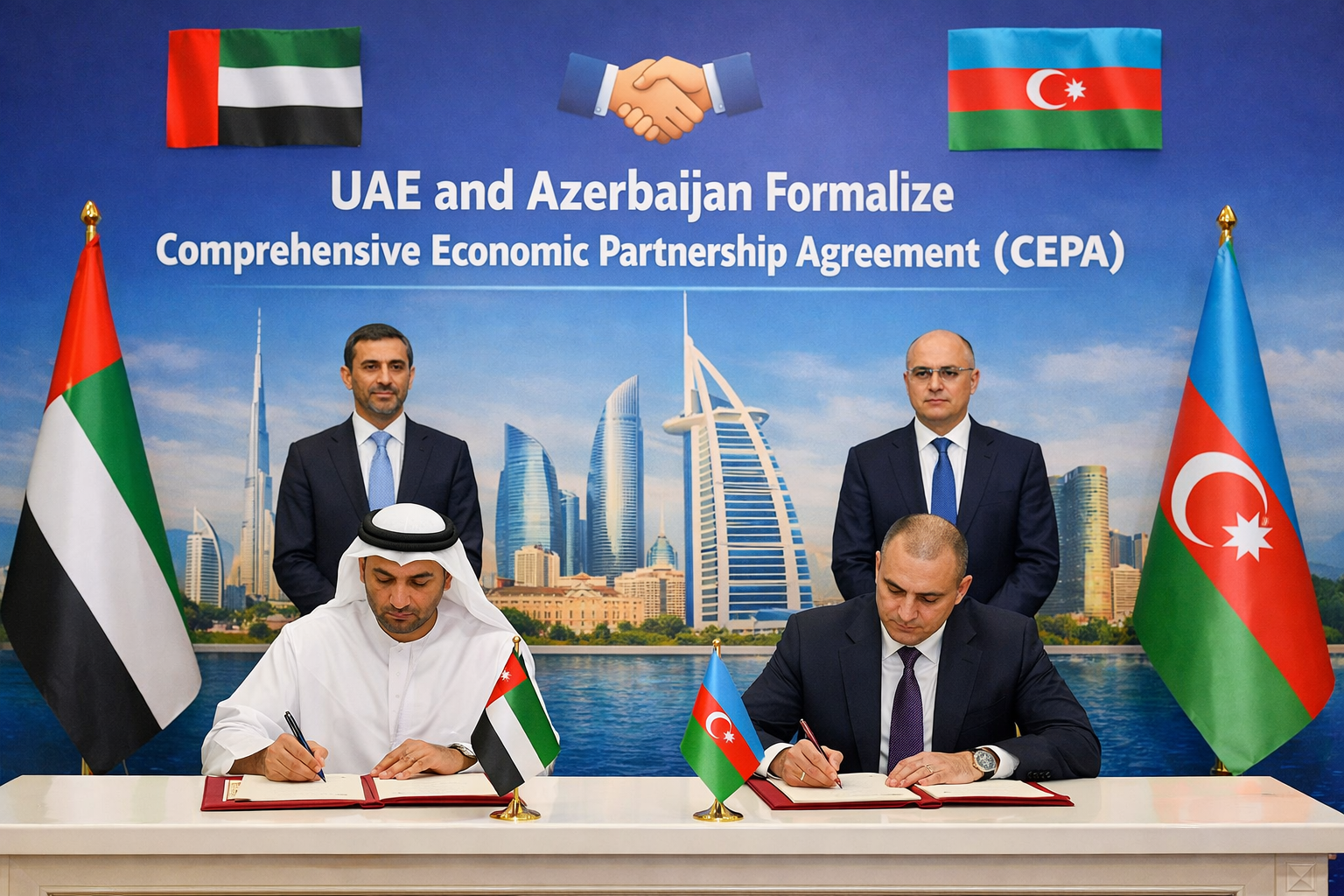
In a move that significantly strengthens the “Middle Corridor” of global trade, the United Arab Emirates and the Republic of Azerbaijan have officially entered into a Comprehensive Economic Partnership Agreement (CEPA). The landmark accord, witnessed by UAE President His Highness Sheikh Mohamed bin Zayed Al Nahyan and Azerbaijani President Ilham Aliyev, marks a transformative shift in the bilateral relationship, moving from diplomatic cooperation to deep economic integration.
According to the Emirates News Agency (WAM) coverage of the agreement, the CEPA is expected to deepen commercial ties by facilitating trade, enhancing investment flows, and opening new avenues for private sector collaboration between the two countries.
Table of Contents
Driving Non-Oil Growth
The formalization of this partnership follows a period of unprecedented commercial momentum. In 2024, non-oil bilateral trade between the two nations surged by 43%, reaching $2.4 billion. The UAE currently stands as Azerbaijan’s leading Arab investor, with a capital footprint exceeding $1 billion.
“The CEPA reflects the UAE’s commitment to building global development partnerships that contribute to sustainable growth and create opportunities for coming generations,” stated His Highness Sheikh Mohamed bin Zayed. He described the agreement as a milestone in the nations’ shared aspirations to build innovation-driven, knowledge-based economies.
Key Sectors for Corporate Expansion
The CEPA is specifically engineered to unlock value in sectors where both nations hold competitive advantages. For corporate entities and investors, the agreement streamlines regulatory pathways in:
- Renewable Energy: Capitalizing on the UAE’s expertise (via Masdar) to support Azerbaijan’s transition to green power.
- Logistics & Infrastructure: Enhancing port efficiencies and supply chain connectivity between the Middle East and Central Asia.
- Agri-tech & Food Security: Facilitating the exchange of technology and goods to stabilize regional food supplies.
- Tourism & Hospitality: Lowering barriers for investment in luxury real estate and travel services.
A Blueprint for Global Integration
For the UAE, the Azerbaijan CEPA is a critical component of the “We the UAE 2031” vision, which aims to propel non-oil foreign trade to $1.1 trillion. This agreement is one of 27 concluded or under-negotiation deals that provide UAE-based businesses with preferential access to markets representing over a quarter of the world’s population.
Dr. Thani bin Ahmed Al Zeyoudi, UAE Minister of Foreign Trade, emphasized that the agreement provides a “rules-based” framework that de-risks market entry for Small and Medium Enterprises (SMEs) and multinational corporations alike.
The Corporate Outlook
As the agreement enters its implementation phase, businesses can expect a significant reduction in administrative “red tape” and a harmonized customs process. For Azerbaijan, the deal provides a gateway to the capital-rich markets of the Gulf; for the UAE, it secures a strategic foothold in a high-growth Caucasian economy.
The UAE-Azerbaijan CEPA is not merely a trade deal; it is a strategic alignment of two of the region’s most ambitious economies, poised to redefine trade flows across the Eurasian landmass.
