

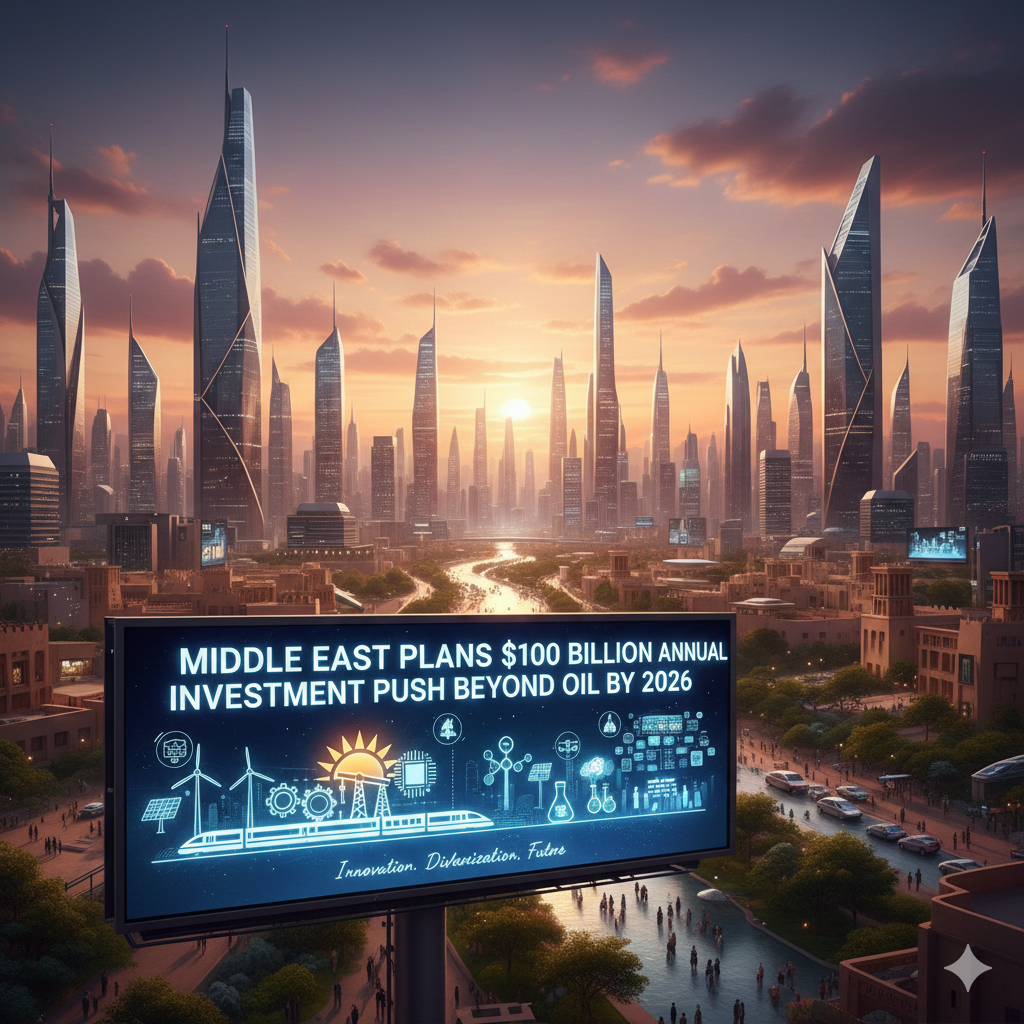
The Middle East is entering a decisive new phase of economic transformation, with governments and state-linked investors planning more than $100 billion a year in capital expenditure by 2026 across sectors that extend well beyond traditional oil and gas.
According to regional investment outlooks, the next wave of growth will be driven by renewable energy, health care, and digital infrastructure particularly data centres and cloud computing as Gulf economies accelerate diversification and build resilience against global energy volatility.
Table of Contents
Diversification without abandoning hydrocarbons
Oil and gas continue to anchor Middle Eastern economies, but the nature of investment is changing. Capital is increasingly flowing into higher-value, cleaner, and technology-driven segments, including LNG, petrochemicals, advanced materials, and lower-carbon fuels.
Rather than moving away from hydrocarbons entirely, countries such as the UAE and Saudi Arabia are repositioning the sector as part of a balanced and resilient energy mix, while simultaneously scaling non-oil industries that support long-term competitiveness.
Renewables Take Centre Stage
Renewable energy is now one of the fastest-growing areas of capital deployment across the Gulf. Large-scale solar and wind projects, supported by battery storage and early hydrogen initiatives, are reshaping regional energy economics.
Falling technology costs, long-term power purchase agreements, and national net-zero commitments are making renewables commercially attractive, even in markets with historically low-cost fossil fuels. The shift is also strengthening energy security and supporting industrial growth.
Health Care Evolves into an Investable Growth Sector
Health care is no longer viewed solely as a public spending obligation. Across the Middle East, it is emerging as a strategic economic sector, supported by private investment, regulatory reform, and digital integration.
Growth drivers include:
- Rising demand for specialty and preventive care
- Expansion of medical tourism
- AI-enabled diagnostics and virtual care platforms
- Integrated national health data systems
In the UAE, medical tourism alone contributes billions of dollars annually, reinforcing health care’s role as a generator of revenue, employment, and service exports.
Data Centres and Cloud Infrastructure Power the Digital Economy
Digital infrastructure is becoming one of the most capital-intensive growth themes in the region. Data centres and cloud platforms now underpin everything from government digitisation and fintech to AI adoption and smart city development.
Market forecasts indicate:
- Double-digit growth in Middle East and Africa data centre capacity between 2025 and 2030
- Even faster expansion in cloud computing, driven by AI workloads and hyperscaler investments
For policymakers, data centres are increasingly treated as critical national infrastructure, comparable to transport, utilities, and energy assets.
Industrial Upgrading and Advanced Manufacturing
Investment is also accelerating in industrial localisation and advanced manufacturing. Automation, robotics, digital twins, and predictive maintenance are being deployed across new industrial clusters and special economic zones, improving productivity and supply-chain resilience.
Reliable energy supply, competitive power pricing, and high-availability digital networks are central to making these industrial strategies viable at scale.
A Diversified Capital Pipeline for Long-term Growth
By 2026, the Middle East is expected to operate with a broader and more diversified capital investment pipeline, where hydrocarbons coexist with clean energy, digital infrastructure, and knowledge-based sectors.
This shift is not just about reducing dependence on oil revenues it is about creating sustainable GDP growth, attracting global capital, generating skilled employment, and positioning the region as a competitive hub for the future economy.
As investment priorities evolve, businesses that align with these emerging sectors stand to benefit from one of the most ambitious economic transitions underway anywhere in the world
