

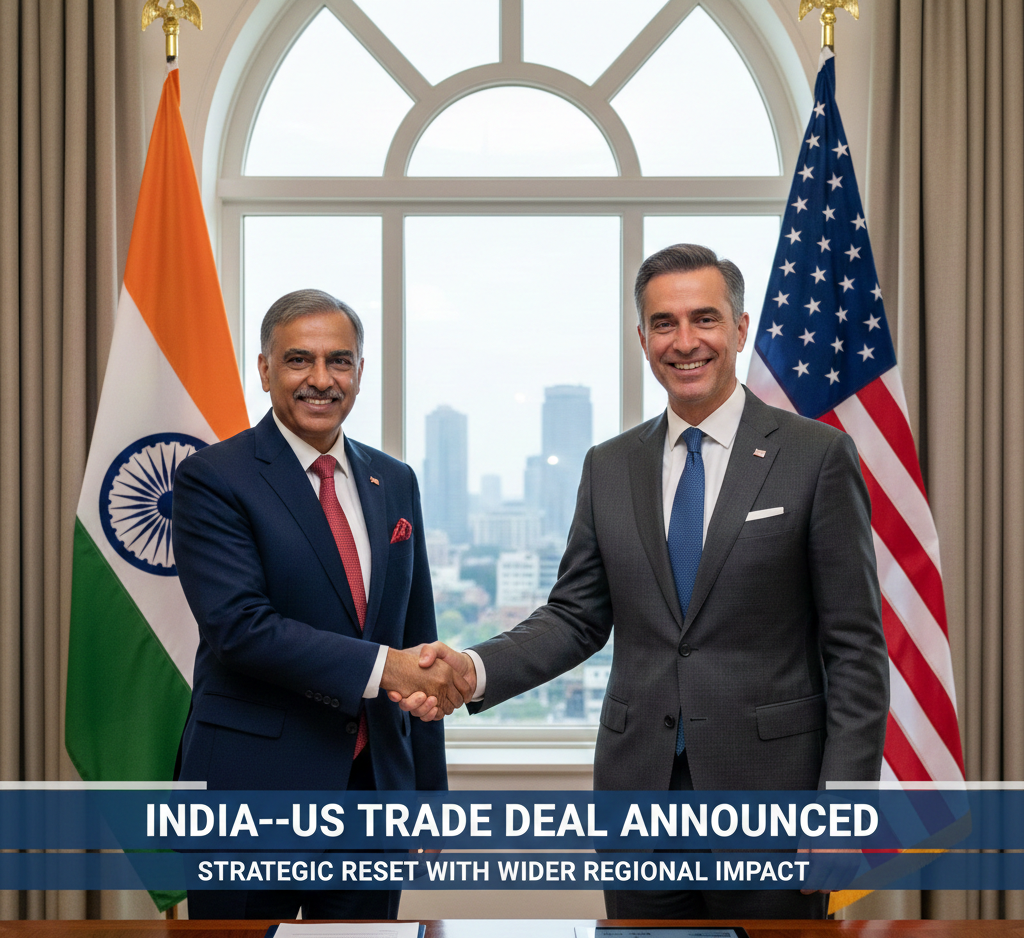
India and the United States have announced a new bilateral trade agreement aimed at easing recent tariff tensions and rebuilding commercial momentum between the two economies. While the deal has been declared at the political level, formal documentation, product-level commitments, and implementation timelines are still under negotiation.
Even at this preliminary stage, the announcement marks an important diplomatic and economic signal one that extends beyond the two countries and carries implications for India’s broader trade architecture, including its fast-growing economic partnership with the United Arab Emirates.
Table of Contents
What Has Been Announced So Far
The framework outlined by both governments indicates a de-escalation of tariff measures that had strained trade flows in 2025. The United States is expected to reduce duties on a range of Indian exports, offering relief to sectors such as manufacturing, engineering goods, textiles, and value-added industrial products.
In parallel, India is expected to expand imports of selected American goods, potentially including energy supplies, defence equipment, aviation assets, and certain agricultural categories. However, sensitive domestic sectors particularly agriculture and dairy are likely to remain areas of careful negotiation.
At present, the agreement represents a strategic intent rather than a fully ratified treaty. Negotiation teams on both sides are expected to work through technical details in the coming months.
Why the Announcement Matters for Global Trade Positioning
The development reflects India’s broader push to rebalance its trade relationships with major economies while strengthening supply chain resilience. Improved access to the U.S. market could enhance India’s export competitiveness, reduce uncertainty for global buyers, and support manufacturing growth aligned with India’s production-linked initiatives.
For the United States, the arrangement supports diversification of supply chains, deeper defence and energy trade cooperation, and closer economic alignment with a key Indo-Pacific partner.
The India–UAE Dimension: Indirect but Significant Effects
Although the agreement is bilateral, its ripple effects could be felt in India’s trade engagement with the UAE, one of its most important economic partners.
UAE’s Role as a Trade and Re-Export Hub
The UAE serves as a strategic logistics and re-export gateway connecting Asia, Africa, Europe, and the Middle East. As Indian exports potentially gain stronger footing in the U.S. market, increased production capacity and trade volumes may also flow through UAE trade corridors, reinforcing the Emirates’ position as a commercial intermediary.
Energy Trade Realignment
Energy trade forms a crucial link in India–UAE relations. As India adjusts its energy import mix under evolving global partnerships, the UAE’s role as a stable supplier of hydrocarbons and LNG may gain additional strategic importance. Diversified sourcing combined with long-term Gulf partnerships could help India manage price volatility and geopolitical risk.
Investment and Industrial Collaboration
Stronger India–US economic ties could encourage multinational companies to expand manufacturing and technology operations in India. This, in turn, may drive higher cross-border investment flows through UAE financial and investment platforms, particularly in infrastructure, logistics, clean energy, and advanced manufacturing.
Supply Chain Integration
The UAE’s logistics infrastructure ports, free zones, and financial hubs positions it as a natural partner in supporting expanded India-linked supply chains. Any increase in Indian industrial output tied to U.S. demand could reinforce trade volumes moving through Gulf trade routes.
Unresolved Areas and Watchpoints
Despite the positive market signal, several aspects remain uncertain:
- Detailed tariff schedules and product lists
- Timelines for implementation
- The scale and structure of India’s import commitments
- How sensitive sectors will be treated in the final text
These factors will determine the depth and durability of the agreement’s economic impact.
Strategic Outlook for Businesses
For corporate stakeholders, the announcement underscores a shifting trade landscape shaped by diversification, regional connectivity, and strategic partnerships. Companies operating across India, the U.S., and the UAE may find emerging opportunities in:
- Cross-border manufacturing and sourcing
- Energy and infrastructure investment
- Logistics and trade facilitation services
- Defence and aviation supply chains
As negotiations advance, businesses will need to monitor policy developments closely to align with evolving trade flows across the India–US–UAE economic corridor.
