

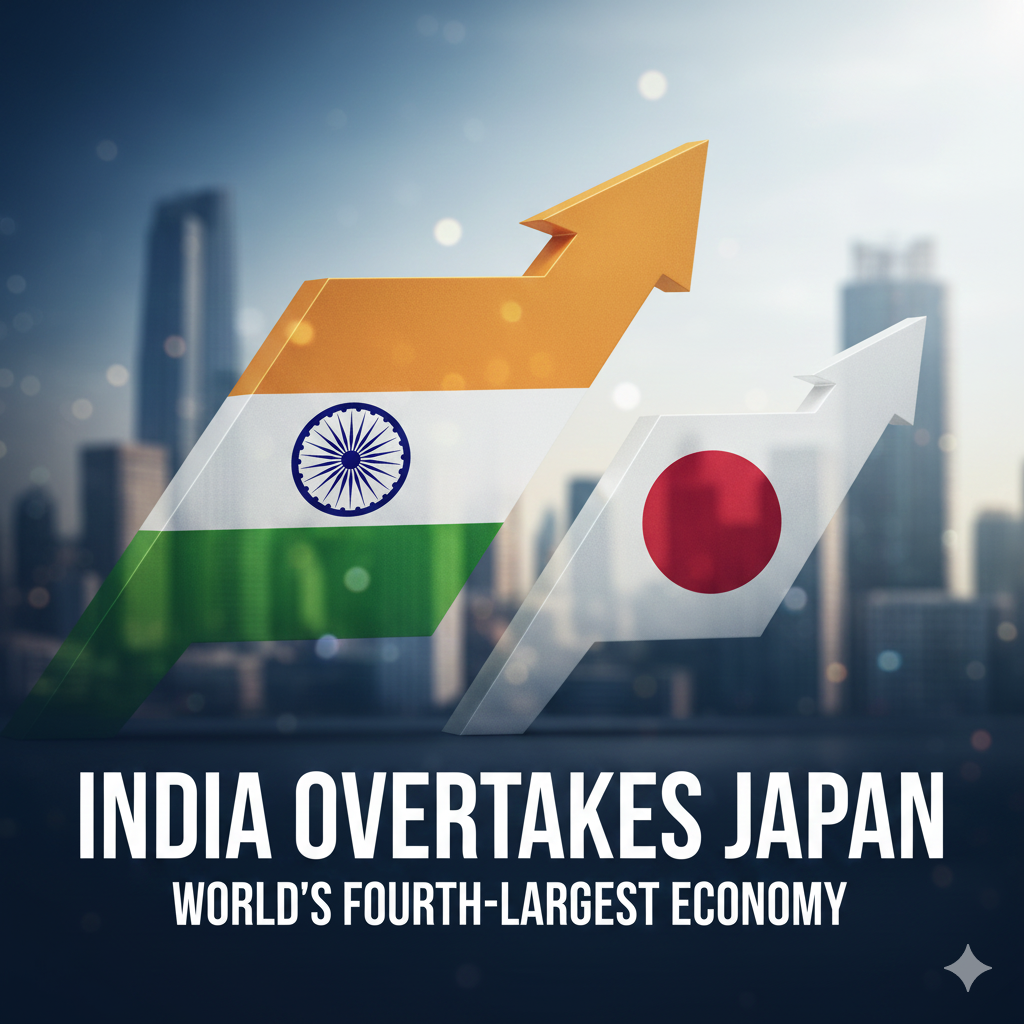
India has achieved a historic economic milestone, overtaking Japan to become the world’s fourth-largest economy, marking a decisive shift in global economic rankings. Measured by nominal GDP, India’s economy is now estimated at over USD 4.1 trillion, placing it behind only the United States, China, and Germany.
This development is more than a headline moment it reflects deep-rooted structural changes, sustained growth momentum, and India’s rising influence in global trade, investment, and geopolitics.
Table of Contents
A Defining Moment in Global Economic Realignment
For decades, Japan held its position among the world’s top four economies, driven by industrial strength and technological leadership. India’s ascent underscores a broader realignment where fast-growing emerging economies are reshaping global economic power, while advanced economies face slower growth and demographic challenges.
India’s rise has been driven by consistent high GDP growth, strong domestic demand, and expanding participation in global supply chains factors that have allowed it to outpace Japan’s relatively stagnant growth trajectory.
What’s Powering India’s Economic Surge?
Several structural and cyclical factors have contributed to India’s rapid climb:
High Growth Among Major Economies
India remains the fastest-growing large economy globally, with GDP growth exceeding 7–8% in recent quarters. This growth stands in sharp contrast to the low-growth environment seen in many developed markets.
Robust Domestic Consumption
A large, urbanising middle class continues to fuel consumption across housing, infrastructure, digital services, and consumer goods providing resilience even amid global uncertainties.
Demographic Advantage
India’s young and expanding workforce offers a long-term productivity and consumption edge, unlike ageing economies such as Japan, where shrinking labour pools weigh on growth.
Structural and Digital Reforms
Reforms spanning taxation, insolvency, digital payments (UPI), manufacturing incentives, and ease of doing business have strengthened economic efficiency and investor confidence.
Stable Financial Conditions
Controlled inflation, healthier bank balance sheets, and improved credit availability have created a favourable environment for private investment and entrepreneurship.
Why Japan Fell Behind
Japan’s economic challenges are structural rather than cyclical. An ageing population, low birth rates, and prolonged deflationary pressures have constrained growth. Additionally, currency depreciation has reduced Japan’s nominal GDP in dollar terms, influencing global rankings.
What This Means for Businesses and Investors
India’s position as the fourth-largest economy reinforces its status as a critical global growth engine. For businesses, this translates into:
- Expanding market opportunities across sectors
- Stronger capital inflows and foreign investment interest
- Greater relevance in global supply chains
- Increased policy focus on infrastructure, manufacturing, and digitalisation
Multinational corporations and investors are increasingly viewing India not just as an emerging market, but as a core strategic market.
The Road to Third Place
India is now widely projected to overtake Germany to become the world’s third-largest economy by around 2030, if current growth trends persist. While challenges remain—ranging from infrastructure gaps to global trade volatility the long-term trajectory remains firmly upward.
India overtaking Japan is not a short-term statistical shift it is a reflection of fundamental economic transformation. As global economic power continues to rebalance, India’s rise signals new opportunities for businesses, investors, and policymakers worldwide.
For organisations planning long-term growth strategies, India is no longer optional it is essential.
