

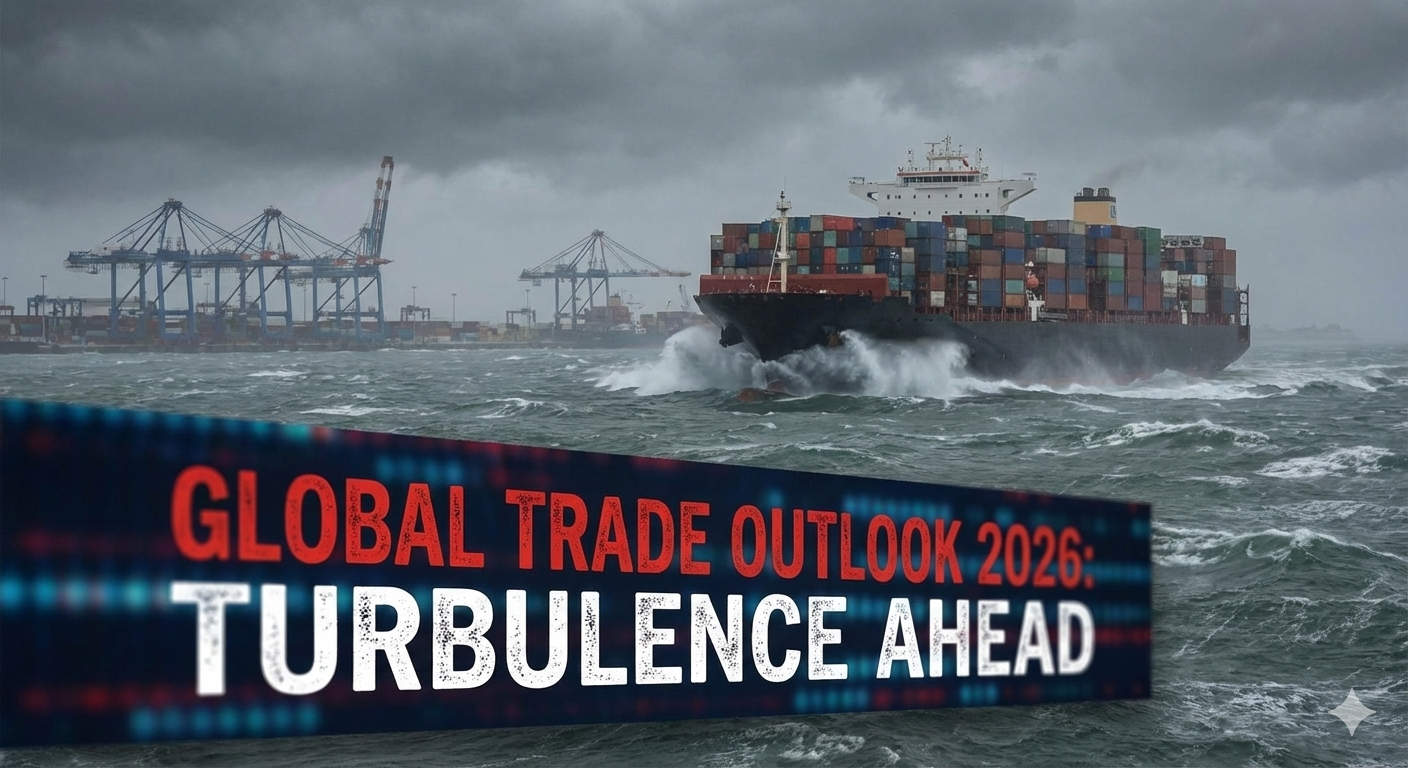
Global trade may be heading into another turbulent phase, with 2026 shaping up to be a challenging year for international commerce, despite recent resilience in merchandise trade volumes. Analysts warn that a combination of logistics disruptions, uneven demand recovery, and fragile trade arrangements could test the stability of global supply chains once again.
According to recent industry and market analysis, the global trading system is concluding one of its most transformational periods in decades. While trade has adapted to higher tariffs, geopolitical tensions, and rerouted shipping lanes, the year ahead may introduce new shocks that threaten both growth and predictability.
Table of Contents
Global Trade Holding Up – But Fault Lines Are Emerging
Global container trade volumes have remained relatively strong, even amid ongoing tariff disputes and geopolitical pressures. Shipping data shows that overall container volumes recorded modest growth year-on-year, indicating that trade flows have not collapsed as many feared.
However, beneath this surface-level resilience lies a significant regional divergence. While inbound trade volumes into the United States have weakened, imports into Africa, the Middle East, Latin America, and India have shown robust growth. This reflects a broader reconfiguration of global trade routes and sourcing strategies, as businesses diversify away from traditional markets.
“Twin Shocks” Loom Over Global Shipping Networks
One of the biggest risks flagged for 2026 lies in global shipping logistics, where two developments could create unexpected disruption.
The first is a potential return of container ships to the Red Sea and the Suez Canal route, following prolonged diversions around southern Africa due to security concerns. While this shorter route between Asia and Europe could reduce transit times, a sudden influx of shipping capacity may overwhelm European ports, triggering congestion, delays, and supply chain bottlenecks.
The second risk is demand-driven pressure, particularly if the US economy accelerates faster than expected. A combination of lower interest rates and renewed investment activity could lead businesses to rapidly rebuild inventories, placing heavy strain on an already stretched global shipping industry.
Fragile Trade Deals Add to Business Uncertainty
Trade policy uncertainty remains another major concern heading into 2026. While several trade agreements have been announced, many lack the binding enforcement mechanisms and long-term clarity businesses rely on for strategic planning.
In particular, the ongoing trade relationship between the US and China remains unresolved, with temporary arrangements replacing comprehensive agreements. This leaves the world’s most significant trading relationship exposed to sudden policy shifts.
At the same time, the United States, Canada, and Mexico are set to review their North American trade framework, opening the door to potentially complex negotiations at a time when political and economic pressures are already elevated.
Legal and Political Risks Could Reshape Trade Overnight
Adding to the uncertainty is a pending legal decision in the United States regarding the legality of reciprocal tariffs introduced in recent years. A ruling could significantly alter tariff policy, with immediate implications for global supply chains, pricing structures, and cross-border contracts.
For businesses operating across multiple jurisdictions, such abrupt policy changes can disrupt sourcing strategies and compliance planning with little warning.
What This Means for Businesses
As 2026 approaches, companies engaged in international trade may need to prepare for:
- Renewed supply chain volatility
- Fluctuating logistics costs
- Increased trade compliance and tariff risks
- Greater importance of diversified markets and sourcing
While global trade is not expected to decline sharply, volatility rather than stability may define the year ahead.
The outlook for global trade in 2026 underscores the importance of flexible supply chains, informed trade planning, and proactive risk management. As trade routes evolve and policy landscapes shift, businesses that stay agile and well-advised will be better positioned to navigate the challenges ahead .
