

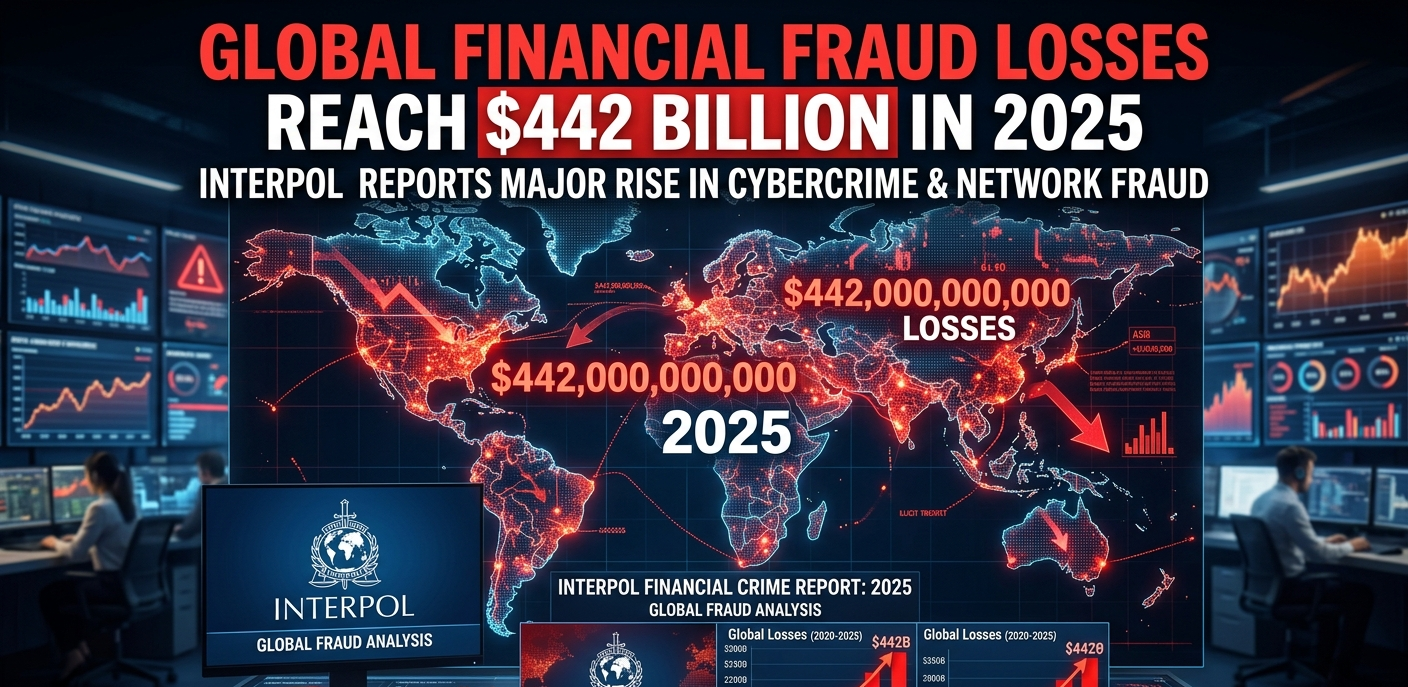
Global financial fraud losses are estimated to have reached $442 billion in 2025, according to the latest assessment by INTERPOL. The findings highlight the scale and rapid growth of financial crime across global markets.
Table of Contents
Rising Global Threat
The estimate is based on INTERPOL’s 2026 Global Financial Fraud Threat Assessment, which classifies the global fraud threat level as high. The agency projects that fraud will continue to expand significantly over the next three to five years, driven by technological advancements and increased cross-border criminal activity.
Role of Artificial Intelligence
The report identifies artificial intelligence and low-cost digital tools as key enablers of modern fraud. AI-enhanced fraud schemes are estimated to be up to 4.5 times more profitable than traditional methods. Emerging “agentic AI” systems are capable of automating various stages of fraud operations, including victim targeting, communication, and fund extraction.
Industrialisation of Fraud Networks
INTERPOL notes a shift toward the industrialisation of fraud, with organised criminal groups operating at scale across multiple jurisdictions. These networks use digital platforms to run coordinated campaigns that often mimic legitimate businesses, increasing the effectiveness of deception.
Common Fraud Typologies
The report highlights several widely observed fraud methods, including:
- Phishing attacks and identity theft
- Impersonation scams
- Fake investment platforms
- Fraudulent online listings and services
Criminals increasingly rely on social engineering techniques to manipulate individuals into disclosing sensitive financial and personal information.
UAE Enforcement and Industry Response
In the UAE, authorities have intensified efforts to counter the growing threat. Public awareness campaigns have been expanded alongside enforcement actions, encouraging residents to verify transactions and report suspicious activity.
Banks and telecommunications providers have strengthened monitoring systems to detect unusual transaction patterns and suspicious communications. Industry participants are also working with regulators to enhance verification frameworks and reduce exposure to fraud risks.
Emerging Scam Patterns
Authorities have reported a rise in targeted fraud schemes, including:
- Fraudulent phone calls requesting identity credentials
- Fake rental listings offered at below-market rates
- Online “side-income” or task-based scams
These schemes often involve initial small payouts to build trust before requesting larger financial commitments from victims.
Cybersecurity Advisory
The UAE Cyber Security Council has warned of increasing risks related to phishing, fake investment platforms, and impersonation schemes. High digital adoption rates are identified as a factor contributing to greater exposure to such threats.
According to INTERPOL Secretary General Valdecy Urquiza, the combination of artificial intelligence, accessible digital tools, and cross-border criminal collaboration is accelerating the scale and complexity of financial fraud.
The report underscores the need for continued coordination between governments, regulators, and private sector entities to strengthen prevention, detection, and response mechanisms in the evolving financial crime landscape.
