

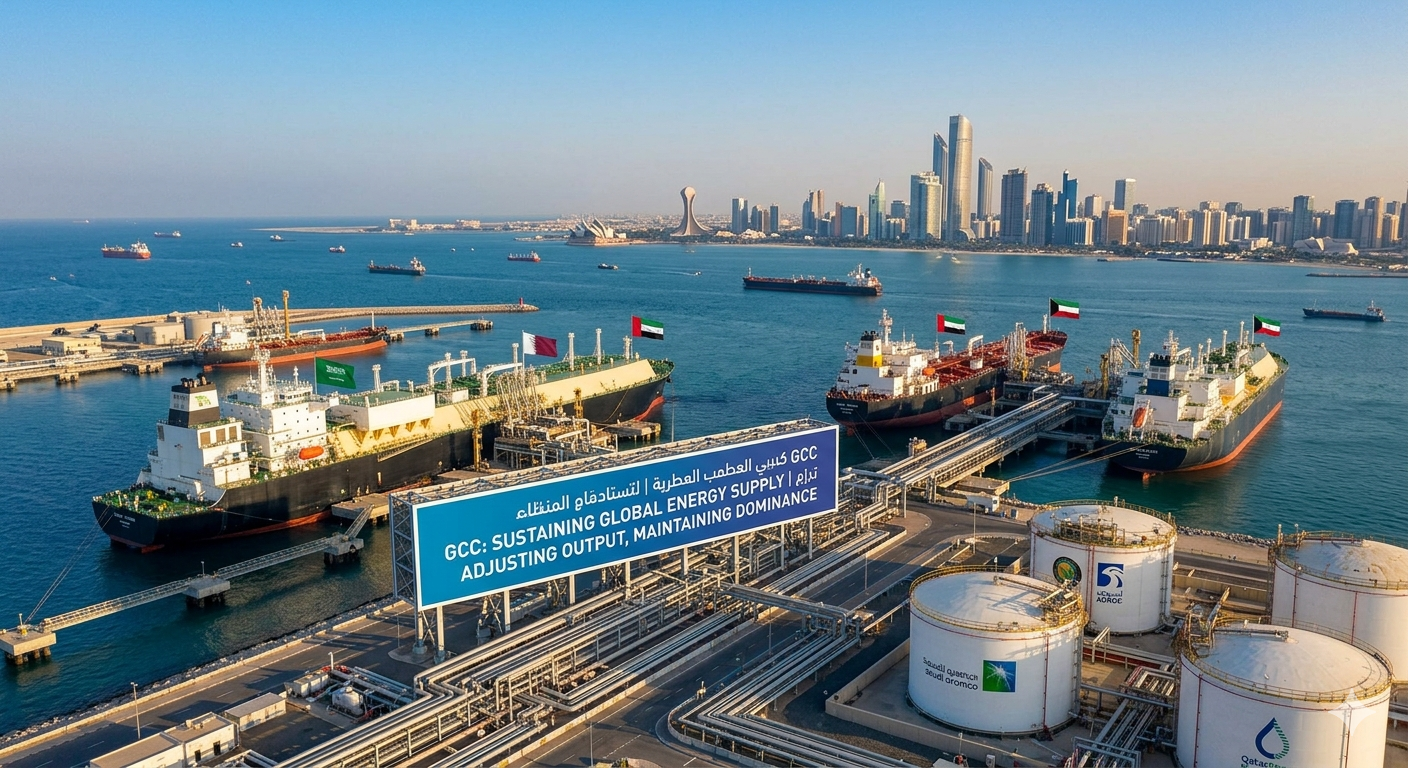
The Gulf Cooperation Council (GCC) continues to command a dominant position in global energy markets, even as member states implement production adjustments in response to shifting market dynamics and coordinated supply strategies.
Recent regional data indicate that the GCC accounts for approximately 21.8 per cent of global crude oil production, alongside a significantly higher 32.7 per cent share of the world’s proven oil reserves. In the natural gas segment, the bloc holds around 21.2 per cent of global reserves, reinforcing its status as a cornerstone of global energy security.
Table of Contents
Structural strength beyond production levels
While crude output across GCC countries recorded a modest decline in 2024, the region’s influence remains structurally intact. Industry observers attribute this resilience to the sheer scale of proven reserves, well-established export infrastructure, and decades of operational expertise in upstream and downstream energy sectors.
According to insights published by the GCC Statistical Centre, the region’s oil sector continues to play a pivotal role in economic output. At current market prices, oil-related activities contributed substantially to regional GDP, underlining the enduring fiscal importance of hydrocarbons despite ongoing diversification efforts.
Strategic role in global supply chains
Despite reduced production volumes, the GCC remains a key supplier to major consuming markets across Asia and Europe. Its ability to modulate output often in alignment with broader producer alliances positions the region as a stabilising force in global oil markets.
Exports, although marginally lower year-on-year, continue to reflect strong international demand, with the Gulf maintaining its role as a reliable energy partner amid geopolitical and economic uncertainties.
Gas sector stability and expansion
The natural gas segment across GCC economies has demonstrated steady performance, supported by sustained production levels and expanding reserves. Proven natural gas reserves in the region remain substantial, contributing over one-fifth of global totals.
Gas continues to play a critical role in domestic energy systems, particularly in power generation, industrial development, and petrochemical production. Its relative stability further complements the region’s broader energy portfolio.
Growth in reserves reinforces long-term outlook
A key factor underpinning the GCC’s continued dominance is the consistent growth in hydrocarbon reserves. Data indicate measurable increases in crude oil reserves over recent years, while natural gas reserves have also recorded incremental gains.
This expanding resource base strengthens the region’s long-term strategic positioning, enabling it to maintain supply leadership even amid global transitions toward cleaner energy systems.
Renewable investments gain momentum
Alongside its traditional energy strengths, the GCC is accelerating investments in renewable energy as part of broader economic and environmental strategies. Solar power projects, in particular, are witnessing rapid expansion, driven by favourable geographic conditions and declining technology costs.
However, renewable capacity currently represents a relatively small share of the global total, indicating that hydrocarbons will continue to underpin the region’s energy landscape in the near to medium term.
As global energy markets navigate volatility, transition pressures, and evolving demand patterns, the GCC’s combination of vast reserves, strategic export capabilities, and gradual diversification positions it as a central player in the future energy mix.
The region’s ability to balance production discipline with long-term resource strength ensures that, despite periodic output cuts, its influence on global energy markets remains firmly intact.
