

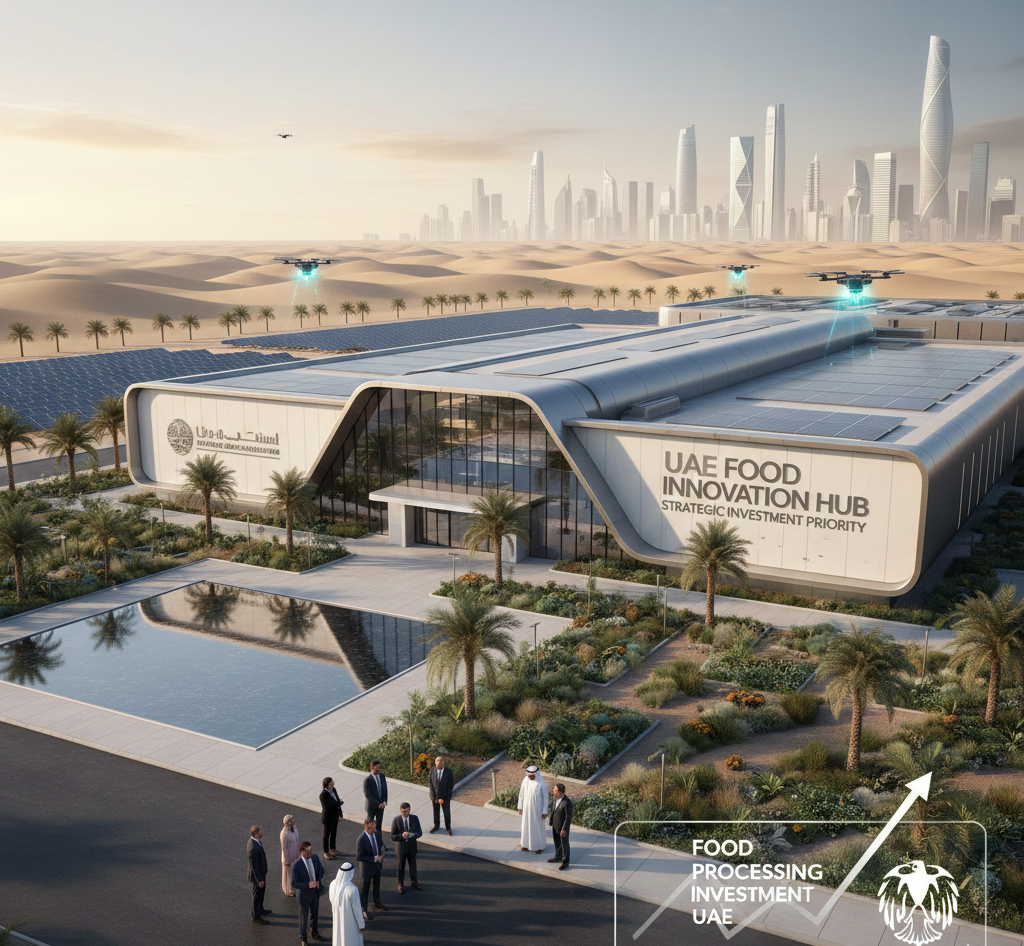
The UAE is placing food and food processing at the centre of its national investment strategy, signalling a major shift in how the country views economic growth, value creation, and long-term food security.
Speaking at the Sharjah Entrepreneurship Festival (SEF) 2026, UAE Minister of Economy and Tourism Abdulla Bin Touq Al Marri highlighted that the greatest economic gains in the food sector lie not merely in cultivation, but in processing, packaging, and transforming raw produce into high-value finished products. His remarks reflect a broader policy direction aimed at strengthening domestic capabilities across the food value chain.
Table of Contents
From Agriculture to Value Addition
Traditionally, agriculture captures only a small portion of the final market value of food products. The UAE’s strategy focuses on what happens after harvest processing, branding, logistics, and export readiness.
The minister illustrated this concept by noting how basic produce gains exponential value once processed and packaged for consumers. This approach positions food processing as a manufacturing and industrial opportunity, not just an agricultural one, aligning it with the UAE’s broader diversification agenda.
For investors and entrepreneurs, this means opportunities extend across:
- Food manufacturing and processing facilities
- Packaging innovation
- Cold chain and storage infrastructure
- Food logistics and distribution
- Agri-tech integration
- Export-oriented value-added products
Link to National Food Security
The UAE imports a significant portion of its food requirements, making food security a strategic priority. By developing local processing capacity, the country is not only enhancing economic resilience but also reducing vulnerability to global supply chain disruptions.
Domestic processing strengthens control over supply chains, improves storage and shelf life, and supports re-export capabilities all of which contribute to a more secure and stable food ecosystem.
Government-Backed Industry Ecosystem
Supporting this shift, the UAE has launched initiatives to build a comprehensive food and food processing ecosystem, involving partnerships across farming, logistics, insurance, and cold storage. The creation of food industry clusters with strong private sector participation reflects a coordinated push to turn the UAE into a regional hub for food trade and value-added production.
These efforts complement the country’s established strengths in:
- World-class logistics and port infrastructure
- Global trade connectivity
- Advanced free zone ecosystems
- Pro-business regulatory frameworks
A New Industrial Growth Frontier
Food processing now joins sectors such as advanced manufacturing, financial services, tourism, and technology as a key pillar of the UAE’s national economic strategy. The emphasis is clear: the future of food investment in the UAE lies in scalability, technology integration, and value creation, rather than primary production alone.
For corporate investors, manufacturers, and international food brands, the UAE’s policy direction presents a compelling proposition a market that combines strategic location, government support, and rising demand for high-quality processed food products across the Middle East, Africa, and Asia.
As global food systems evolve, the UAE is positioning itself not just as an importer, but as a value-adding food economy built around processing, innovation, and trade.
