

Table of Contents
VAT Filing Is Not About Data Entry – It’s About Data Integrity
VAT returns in the UAE are straightforward in theory, but in practice, companies often underestimate the depth of preparation needed for an accurate and defensible submission. A VAT return is not merely an online form; it is a financial statement reflecting how well your business has documented, classified, and reconciled its transactions over the tax period.
The Federal Tax Authority’s EmaraTax platform streamlines the filing process, yet the correctness of the numbers you enter still depends entirely on your internal controls. A well-filed return demonstrates strong governance. A flawed return reveals gaps in accounting, documentation, or VAT logic – gaps that can lead to penalties, refund rejections, or review notices.
Understanding What the VAT Return Represents
Each VAT return reflects:
- Your total taxable and non-taxable supplies
- Input VAT you are eligible to recover
- VAT due under reverse charge
- Import VAT as per customs records
- Adjustments such as credit notes or output VAT corrections
The return is not a summary of sales and expenses; it is a structured compliance declaration. If your accounting records do not mirror what you report, discrepancies become visible during automated FTA checks or manual audits.
Companies with multiple income streams, cross-border transactions, or complex input VAT patterns must ensure that their financial statements and VAT reports speak the same language. Consistency across systems is the foundation of smooth VAT filing.
Step-by-Step Structure for Filing VAT Returns Accurately
Reconcile sales and supplies before touching the return
Start with a clean reconciliation of your revenue streams. Confirm that all invoices issued during the period have:
- Correct VAT treatment
- Accurate date of supply
- Proper valuation
This is particularly important for businesses with zero-rated exports or Designated Zone transactions, as these require supporting documentation.
Validate input VAT with proper evidence
Before assuming any VAT is recoverable, review the supporting documents:
- Tax invoices
- Supplier TRNs
- Proof of payment (where required)
- Contracts, schedules, or service descriptions
The UAE VAT law is clear input VAT is recoverable only when the documentation meets specific standards. Recovering VAT without compliant evidence is one of the most common triggers for post-filing FTA queries.
Record reverse charge entries accurately
For imported services or reverse charge-eligible transactions, ensure the internal postings correctly reflect:
- Output VAT under reverse charge
- Input VAT recovery (when allowed)
Many companies discover late in the process that reverse charge entries were omitted or posted with the wrong tax codes. Correcting these after submission is time-consuming and sometimes penalised.
Match customs records with the FTA portal
Import VAT visible in your EmaraTax account originates from UAE Customs declarations. Before filing, ensure:
- All imports during the tax period appear under the correct TRN
- No declarations were mistakenly linked to personal customs codes
- Designated Zone movements are documented accurately
This is a critical step because customs imports are among the most scrutinised elements of the VAT return.
Incorporate credit notes and adjustments
If credit notes were issued during the period, these must be reflected in the VAT return. Ensure:
- Adjustments appear in the correct section
- They reference the original invoices
- They reduce output VAT for the correct period
Incorrectly timed adjustments create inconsistencies that can draw regulatory attention.
Templates for Clean, Audit-Ready VAT Filing
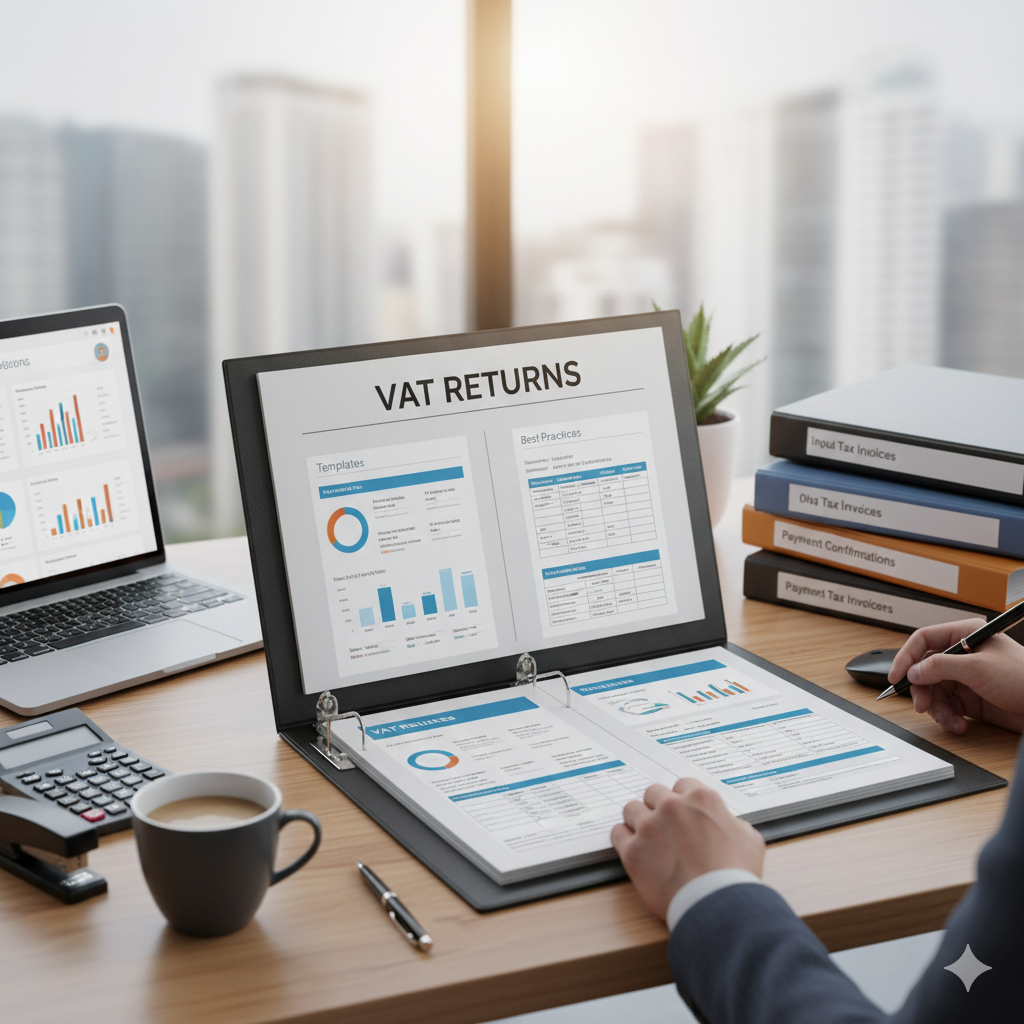
Below are streamlined templates you can adapt internally. These are based on best practices used in UAE VAT consulting engagements.
VAT Output Summary Template
| Category | Amount | VAT Rate | VAT Amount | Notes |
| Standard-Rated Supplies | 5% | |||
| Zero-Rated Supplies | 0% | |||
| Exempt Supplies | N/A | |||
| Out-of-Scope Supplies | N/A |
This template helps isolate taxable outputs from exempt activities, an essential step for determining input VAT recoverability later.
Input VAT Recovery Template
| Supplier | TRN | Invoice Value | VAT Amount | Recoverable? | Reason |
| Yes/No | Example: missing TRN, incomplete description, personal expense |
Maintaining this table ensures your recovery position is backed by robust evidence.
Reverse Charge Summary Template
| Supplier | Country | Service Description | VAT to Declare | VAT Recoverable | Notes |
This template highlights the two-sided nature of reverse charge: VAT payable and VAT recoverable.
Best Practices to Ensure Every VAT Return Is Clean and Defensible
Create a monthly VAT reconciliation rhythm
Waiting until the end of the quarter increases the risk of errors. Monthly VAT reconciliations ensure transactions are reviewed while documentation is still easy to obtain.
Maintain consistent tax codes across systems
ERP, accounting software, and manual files should use consistent tax codes. A mismatch is the quickest path to filing discrepancies.
Keep Export and Designated Zone evidence organised
Export proofs, customs exit documents, delivery confirmations, and contracts should be stored chronologically. Missing evidence converts zero-rated transactions into standard-rated ones during audits.
Conduct internal pre-submission reviews
A simple internal peer review of the draft VAT return comparing numbers against ledgers, customs data, and invoices prevents most filing errors.
Retain records for the legally required duration
The FTA requires VAT records to be maintained for at least five years, and longer for real estate. Organised record-keeping protects your business during audits or refund reviews.
Ensuring Accurate and Defensible VAT Compliance
Correct VAT filing in the UAE is built on the principle of consistency between documentation, accounting records, customs declarations, and the final figures entered in EmaraTax. When each component aligns, filing becomes a simple, repeatable compliance exercise. When they do not, errors accumulate and eventually impact cashflow, refund eligibility, or trigger regulatory scrutiny.
A structured internal process, combined with clear templates and timely reconciliations, ensures every VAT return submitted is accurate, compliant, and fully defensible.