

Table of Contents
Why VAT Filing Errors Still Happen in 2025
Even after several years of VAT implementation in the UAE, filing errors remain one of the most common compliance challenges for companies. The UAE’s VAT system is straightforward, but the reality inside businesses is not: different departments handle purchases, invoices come from dozens of suppliers, exports rely on timely documentation, and reverse-charge entries are often misunderstood.
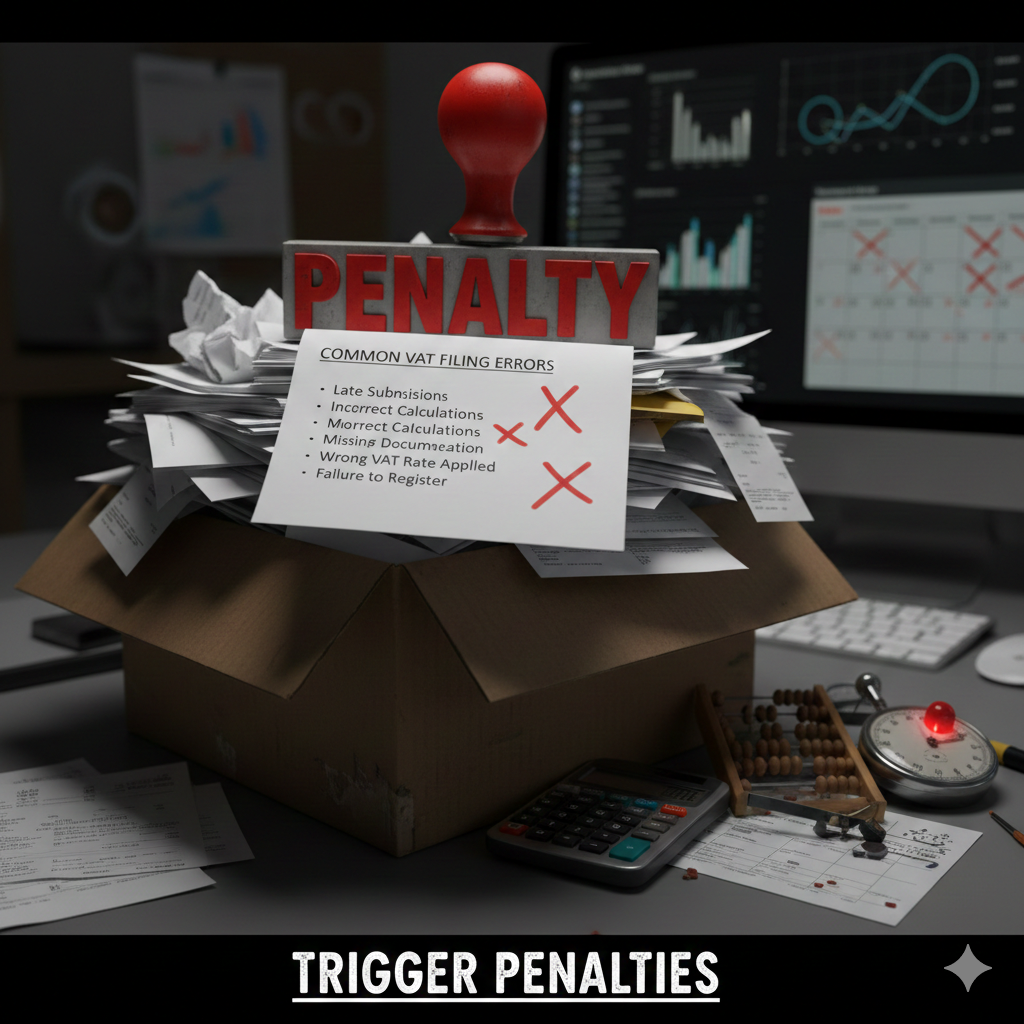
The Federal Tax Authority (FTA) has built a strong, fully digital environment through EmaraTax, making discrepancies easier to identify and therefore easier to penalise. Errors that may seem minor, such as a wrong tax code or missing import declaration, can trigger significant penalties or FTA review notices.
Misreporting Output VAT Due to Incorrect Tax Treatment
Many filing discrepancies begin at the invoicing stage. If a supply is incorrectly categorised standard-rated instead of zero-rated, or vice versa, your output VAT figure in the return becomes inaccurate.
This often occurs when:
- Contracts do not specify whether prices are VAT-inclusive or VAT-exclusive
- A Free Zone company assumes transactions are automatically zero-rated
- Exports are declared as zero-rated without collecting correct export evidence
- Mixed supplies (residential vs commercial) are incorrectly classified
Because output VAT directly affects the amount payable to the FTA, even a small misclassification results in misreporting, and the FTA may request transaction-level breakdowns during review.
Claiming Input VAT Without Valid Documentation
Input VAT recovery is one of the strongest benefits of the UAE VAT system, but the rules are strict. The FTA does not accept claims supported by incomplete or incorrectly formatted tax invoices. The most frequent issues include:
- Missing supplier TRN
- Incorrect invoice dates
- Invoices issued to the wrong entity
- Vague or generic service descriptions
- Missing VAT amount breakdown
The FTA’s invoice requirements are clearly documented in the VAT legislation and Public Clarifications on their site.
If documents do not match the standards, the input VAT becomes non-recoverable. For some companies, especially those with high import or service-related expenses, this can materially affect profitability.
Failing to Declare Reverse Charge on Imported Services
One of the most overlooked VAT filing requirements is the reverse charge mechanism on imported services. Businesses often assume VAT applies only to outflows, but when they purchase services from a foreign supplier software, marketing, consultancy, subscriptions, they must self-account for VAT.
The most common errors include:
- Ignoring reverse charge entries entirely
- Reporting imports only in customs code-linked fields, not reverse charge fields
- Misunderstanding whether a service qualifies as “imported”
Failure to declare reverse charge VAT results in underreported output VAT, which is treated as a non-compliance violation and penalised accordingly.
Incorrect Reporting of Imports from Customs (Especially via Multiple Codes)
Businesses that import through more than one customs code often face reconciliation gaps between customs declarations and VAT returns. The FTA and UAE Customs systems are integrated, meaning that any mismatch becomes visible during automated checks.
Common triggers include:
- Imports recorded under a director’s personal customs code
- Failure to link all customs codes to the FTA TRN
- Delayed customs updates not matched during VAT filing
- Goods stored in Designated Zones but declared under mainland entries
When mismatches appear, the FTA may issue a “VAT Return Review” request, requiring import documents and reconciliation files.
Using Incorrect Tax Codes in Accounting Systems
ERP and accounting system errors are among the most common yet least visible sources of VAT penalties. A single incorrect tax code selection can cascade into multiple incorrect postings across transactions.
Problem areas include:
- Zero-rated codes used where exempt treatment applies
- Reverse charge entries posted under standard output VAT codes
- Designated Zone supplies incorrectly classified
- Manual journal entries bypassing VAT coding controls
These errors distort both input and output VAT figures, leading to inconsistencies between transactional data and VAT returns.
Missing Adjustments for Credit Notes or Bad Debts
If a business issues credit notes or adjusts the value of supplies, this must be reflected in the VAT return for that tax period. However, companies often:
- Forget to adjust output VAT for issued credit notes
- Overlook bad debt relief adjustments
- Fail to match credit notes to original invoices
- Apply adjustments in the wrong period
Improper adjustments can cause multi-period inconsistencies that attract penalties or trigger FTA queries.
Filing Late or Paying VAT Late
Timely VAT compliance is a critical obligation for VAT-registered businesses in the UAE. To balance enforcement with proportionality, the UAE revised its administrative penalty framework through Cabinet Decision No. 49 of 2021, amending Cabinet Decision No. 40 of 2017. These provisions remain the latest applicable rules governing late VAT filing and late VAT payment.
Penalties for Late Filing of VAT Returns
VAT returns must be submitted by the deadline prescribed by the FTA, generally within 28 days from the end of the tax period. Failure to comply results in fixed administrative penalties, regardless of whether VAT is payable, refundable, or nil.
| Nature of Non-Compliance | When the Penalty Applies | Penalty Amount (AED) | Compliance Implication |
| VAT return not submitted by the due date | First instance of late filing | 1,000 | Triggered immediately after the filing deadline |
| Repeated late submission of VAT return | Same violation repeated within 24 months | 2,000 | Higher penalty reflects recurring non-compliance |
Late filing penalties are procedural in nature and apply even where no VAT liability exists.
Penalties for Late Payment of VAT
Where a VAT return is submitted on time, but payment is delayed, penalties are calculated as a percentage of the unpaid VAT and escalate with time.
| Delay Stage | Reference Point | Penalty Basis | Resulting Exposure |
| Initial non-payment | Immediately after the payment due date | 2% of the unpaid VAT | One-off penalty once the deadline is missed |
| Ongoing non-payment | After one month from the VAT payment due date | 4% per month on the outstanding VAT | Accumulates for each month of delay |
| Extended non-payment | Long-term outstanding VAT | Penalties capped at 300% of unpaid VAT | Prevents unlimited accumulation while remaining substantial |
Beyond filing and payment delays, several ongoing compliance failures continue to expose businesses to administrative penalties.
Not Maintaining Records for the Required Duration
The FTA imposes strict record-keeping obligations on VAT-registered businesses. Records must be retained for at least five years, and for real estate-related activities, for fifteen years. Missing or incomplete documentation constitutes non-compliance even if VAT returns are otherwise accurate.
Required records include tax invoices, contracts, import and export documentation, accounting ledgers, bank statements, and transaction correspondence. During audits, the FTA expects records to be complete, consistent, and readily traceable. Failure to meet these expectations may result in denied VAT recovery, supply reclassification, or administrative penalties.
Strengthening VAT Accuracy Through Operational Discipline
VAT filing errors in the UAE are rarely caused by a lack of understanding of the law. Instead, they usually stem from fragmented internal processes, missing documentation, inconsistent accounting treatment, or failure to reconcile data before submission. The FTA’s digital systems are designed to identify even small irregularities, and penalties apply regardless of whether the mistake was intentional.
A strong VAT compliance framework supported by clear procedures, timely reconciliations, and accurate classification can prevent these errors entirely. For companies aiming to maintain a clean compliance record, VAT accuracy is no longer an accounting task; it is a continuous operational discipline.