

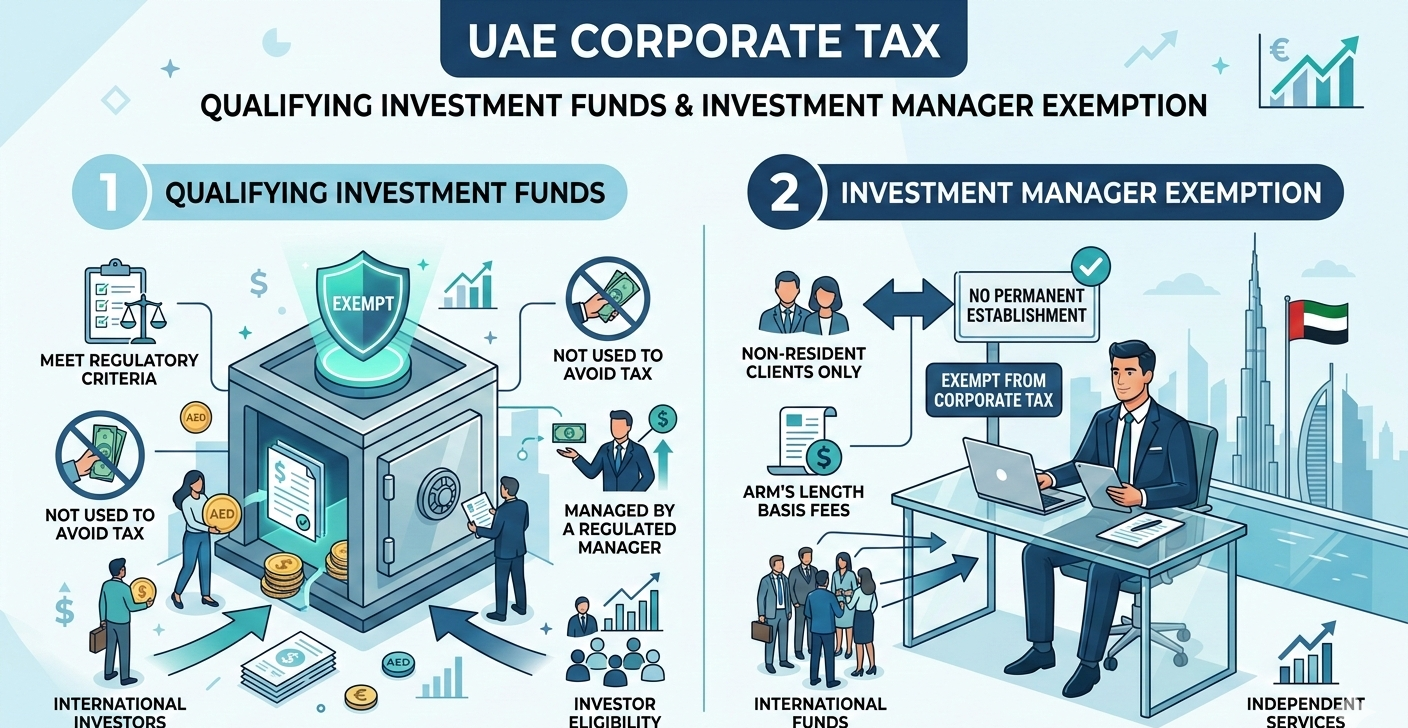
The UAE Corporate Tax regime under Federal Decree-Law No. 47 of 2022 establishes a dedicated framework for investment funds and their managers, aimed at preserving tax neutrality while safeguarding against abuse.
Qualifying Investment Funds (QIFs) may benefit from corporate tax exemption under Article 4, provided the conditions of Article 10 and relevant Cabinet Decisions are satisfied. In parallel, certain income earned by regulated investment managers in connection with QIFs may receive specific treatment under implementing regulations.
For fund sponsors, asset managers, and institutional investors, the regime creates significant structuring opportunities. but only where diversification, regulatory, and governance requirements are demonstrably met.
Table of Contents
Qualifying Investment Funds (QIFs): Legal Framework
A fund may qualify as a QIF where it:
- Is established in the UAE or a foreign jurisdiction.
- Is subject to regulatory oversight by a competent authority (e.g., SCA, DFSA, FSRA, or an equivalent foreign regulator).
- Conducts investment business as its principal activity.
- Satisfies prescribed ownership and diversification requirements.
- Does not permit investors to exercise control over day-to-day management.
Importantly, QIF status is not automatic. It requires:
- Application to and approval by the Federal Tax Authority (FTA); and
- Continuous compliance with all qualifying conditions.
Failure to maintain eligibility may result in loss of exempt status.
Diversification and Ownership Conditions
While specific thresholds are set out in implementing decisions rather than the Law itself, the framework generally requires:
- No single investor (together with Related Parties) to exceed prescribed ownership or profit entitlement thresholds.
- A minimum number of investors, or alternatively, a minimum spread of economic participation.
- Absence of investor control over fund affairs.
Temporary breaches may be tolerated where corrective action is taken within prescribed timelines.
Failure to meet diversification requirements may result in:
- Loss of QIF status.
- Corporate tax exposure at fund level.
- Potential retroactive adjustments.
Qualifying Limited Partnerships (QLPs)
Limited partnerships structured for collective investment may qualify under the same principles, provided:
- They are established and regulated in accordance with UAE law.
- They meet ownership and diversification requirements.
- They apply for and obtain QIF-equivalent treatment.
This is particularly relevant for private equity and venture capital structures.
Tax Treatment of QIFs
Where approved:
- The QIF is treated as an Exempt Person under Article 4.
- It is not subject to the 9% Corporate Tax rate on qualifying income.
However:
- Non-qualifying income or failure to maintain eligibility may trigger taxation.
- Compliance obligations remain (e.g., registration, record keeping).
Exemption applies at the fund level taxation may arise at investor level depending on ownership thresholds and specific circumstances.
Investment Manager Income: Treatment Under the UAE Framework
The Corporate Tax Law does not provide a blanket exemption for all investment manager income.
Instead, implementing decisions clarify that certain income derived from managing QIFs may receive specific treatment where conditions are met.
Key Principles
- Management fees earned by a UAE manager are generally taxable at 9%.
- Carried interest or profit allocations must be assessed under general tax principles.
- Arm’s length pricing rules under UAE transfer pricing regulations apply.
There is no automatic exemption for managers simply because they manage a QIF.
Where specific implementing rules provide relief, this is conditional and subject to:
- Regulatory status of the manager.
- Nature of services.
- Proper contractual and accounting separation.
Managers must maintain robust documentation to support characterization of income.
Investor-Level Implications
Investors in QIFs generally exclude exempt fund income from their own taxable base, subject to:
- Ownership thresholds.
- Control tests.
- Related Party aggregation rules.
If an investor exceeds prescribed ownership thresholds, look-through or attribution principles may apply.
Accordingly, investor structuring must be modelled carefully at fund formation stage.
Compliance and Governance Requirements
To preserve QIF status, fund sponsors must implement:
Diversification Monitoring
Real-time tracking of ownership percentages and related party aggregation.
Regulatory Confirmation
Ongoing evidence of regulatory supervision.
Marketing Documentation
Evidence of genuine commercial fundraising.
Transfer Pricing Support
Where related parties are involved.
Annual Reporting and FTA Interaction
Including registration and maintenance of exempt status.
Loss of status can have significant reputational and financial implications.
Strategic Considerations for Fund Sponsors
To optimize the UAE regime:
- Structure early to meet diversification tests.
- Avoid concentrated related-party investor bases.
- Align carried interest arrangements with arm’s length principles.
- Coordinate QIF approval with regulatory licensing timelines.
- Model Pillar Two exposure for multinational investors.
The UAE framework is competitive internationally, but not permissive of artificial arrangements.
Executive Perspective: Precision Over Assumption
The UAE’s QIF regime is designed to preserve tax neutrality for genuine investment vehicles while protecting the integrity of the Corporate Tax system.
For funds that meet diversification, governance, and regulatory requirements, exemption is a powerful structuring advantage.
However:
- Status is conditional.
- Manager income is not automatically exempt.
- Investor attribution rules can trigger taxation.
- Pillar Two adds a new layer of complexity.
Sponsors and managers must treat QIF qualification as a compliance discipline, not a structural assumption.