

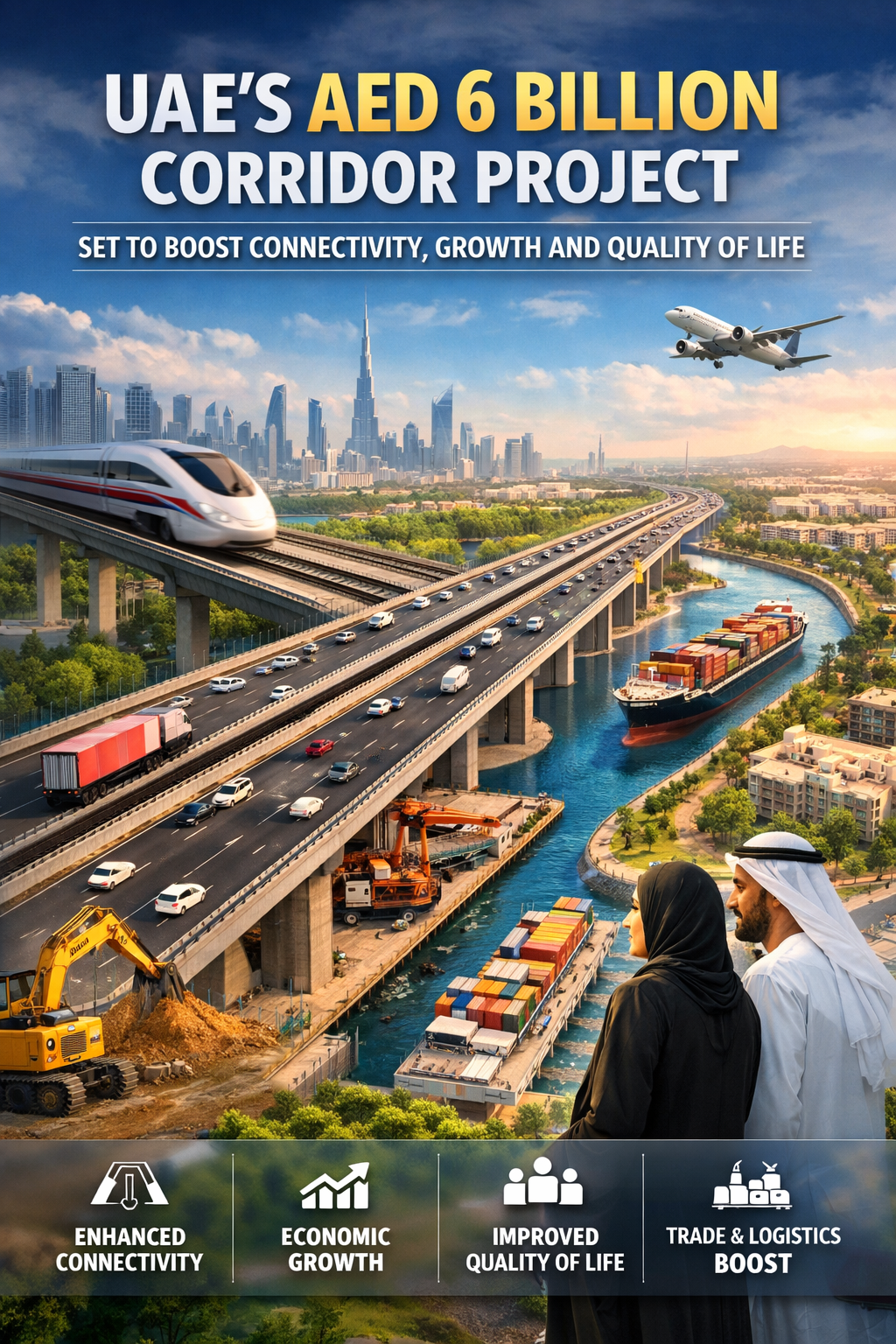
In a significant move to strengthen regional infrastructure and support long-term economic expansion, UAE authorities have unveiled plans for a AED 6 billion transport corridor project linking Dubai, Sharjah, and Ajman.
The large-scale development is designed to address traffic congestion across one of the country’s busiest commuter routes while opening new opportunities for business growth, employment mobility, and improved quality of life for residents.
Table of Contents
Major Infrastructure Expansion
The project includes the construction of a 68-kilometre highway featuring six to eight lanes in each direction, along with 10 major interchanges and four flyovers.
Planned as a high-capacity corridor, the route is expected to significantly ease pressure on existing roads connecting the three emirates, many of which face severe congestion during peak travel hours.
The initiative reflects the UAE’s continued commitment to expanding critical infrastructure in line with rising urban populations and increasing cross-emirate movement.
Faster Commutes, Better Quality of Life
One of the key objectives of the project is to reduce travel time by up to 50%, offering major relief to thousands of professionals and workers who commute daily between Dubai, Sharjah, and Ajman.
Shorter travel times are expected to improve overall quality of life by reducing commuting stress, increasing personal time, and enhancing work-life balance for residents.
For businesses, improved employee mobility can also contribute to higher productivity and better workforce accessibility.
Public Transport Integration
Alongside the highway network, the plan also integrates a Bus Rapid Transit (BRT) system with 10 dedicated routes.
The BRT network will connect city centres, residential communities, and metro stations, creating a faster and more reliable public transport option for daily commuters.
This integrated mobility approach supports the UAE’s broader vision for smart and sustainable urban transport systems.
New Economic and Employment Opportunities
Beyond easing congestion, the project is expected to generate substantial economic value across the connected emirates.
Large-scale infrastructure developments of this nature typically create opportunities across multiple sectors, including:
- construction and engineering
- transport and logistics
- real estate and community development
- retail and commercial services
- public transport operations
Improved connectivity can also stimulate business expansion by making it easier for companies to access talent pools across multiple emirates.
This is particularly important for sectors that rely on daily workforce movement, such as corporate services, retail, manufacturing, and logistics.
Driving Regional Growth
The corridor is also expected to strengthen economic integration between Dubai, Sharjah, and Ajman by improving access to business districts, industrial zones, and residential hubs.
Enhanced infrastructure often acts as a catalyst for new investment opportunities, real estate demand, and commercial development, supporting continued expansion across the northern emirates.
For investors and businesses, the project signals the UAE’s sustained focus on future-ready infrastructure as a foundation for long-term economic growth.
