

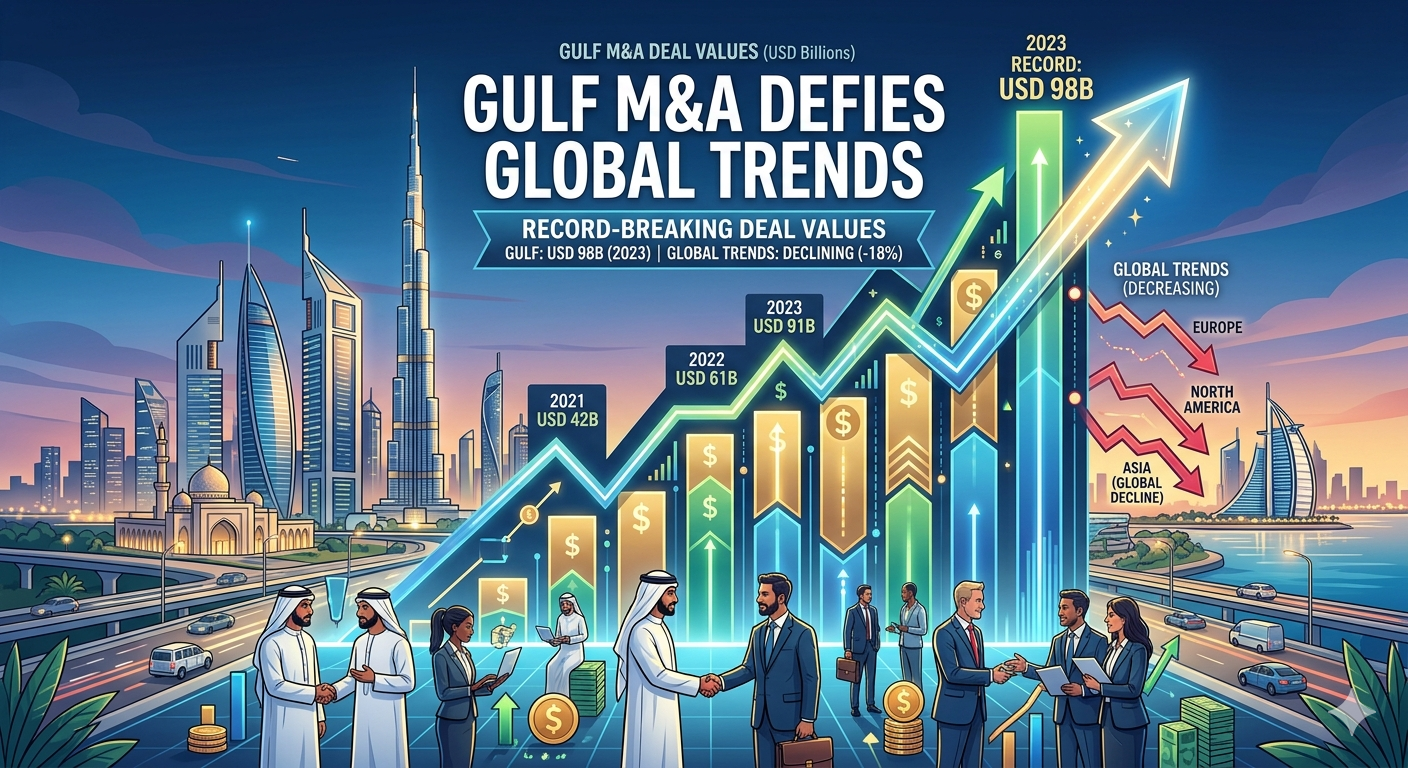
While the global mergers and acquisitions (M&A) landscape faced a cooling period over the past year, the Middle East and Africa (MEA) region has emerged as a powerhouse of resilience and expansion. According to a comprehensive new report by Marsh McLennan, the regional deal market is experiencing a significant “boom,” powered by the UAE’s aggressive economic diversification and deep sovereign liquidity.
The report highlights a sophisticated shift in the regional economy, where high-value strategic acquisitions are becoming the new standard for corporate growth.
Table of Contents
UAE Leads the Regional Surge
The UAE remains the undisputed focal point of this activity, successfully attracting over $30 billion in Foreign Direct Investment (FDI). This influx is not merely a result of traditional capital flow but a calculated move toward future-proofing the national economy.
“The UAE is effectively decoupling itself from global volatility,” the report suggests, pointing to the nation’s stable regulatory environment and business-friendly reforms as primary magnets for international investors.
Key Performance Indicators from the Marsh McLennan Report
The data reveals a market that is maturing rapidly in both scale and complexity:
- Skyrocketing Deal Values: The median deal size in the region has climbed to $390 million, with “mega-deals” in the technology and infrastructure sectors frequently crossing the $1.5 billion to $2.5 billion threshold.
- Sector Diversification: While energy remains a pillar, the most significant growth is now seen in Renewable Energy (Energy Transition), Fintech, and Digital Infrastructure.
- Strategic Buyer Dominance: Large regional corporations and Sovereign Wealth Funds (SWFs) like ADIA, Mubadala, and ADQ are the primary drivers, utilizing vast cash reserves to acquire global technology and expertise.
A Global Advantage in Transaction Risk
One of the most compelling findings in the report is the region’s competitive edge in Transaction Risk Insurance. As the cost of Warranty and Indemnity (W&I) insurance rose in the US and Europe, the Middle East maintained historically low premium rates.
This “insurance advantage” has made it significantly more cost-effective for firms to close complex, high-stakes deals in the Gulf compared to other global financial hubs. The increased adoption of these financial tools signals that the regional market has reached a level of legal and structural sophistication on par with London and New York.
Breakdown of M&A Activity
The report categorizes the current deal flow into three distinct streams:
- Domestic (44%): Intrastate consolidations as regional players scale up.
- Outbound (32%): Gulf-based entities acquiring assets in Europe, Asia, and North America.
- Inbound (24%): International firms seeking a foothold in the MEA’s growing consumer and industrial markets.
While the report maintains a bullish outlook for the remainder of the year, it notes that geopolitical shifts remain the primary variable for 2026. However, with the current momentum in energy transition and the digital economy, the Middle East is well-positioned to maintain its status as a global leader in corporate dealmaking.
