

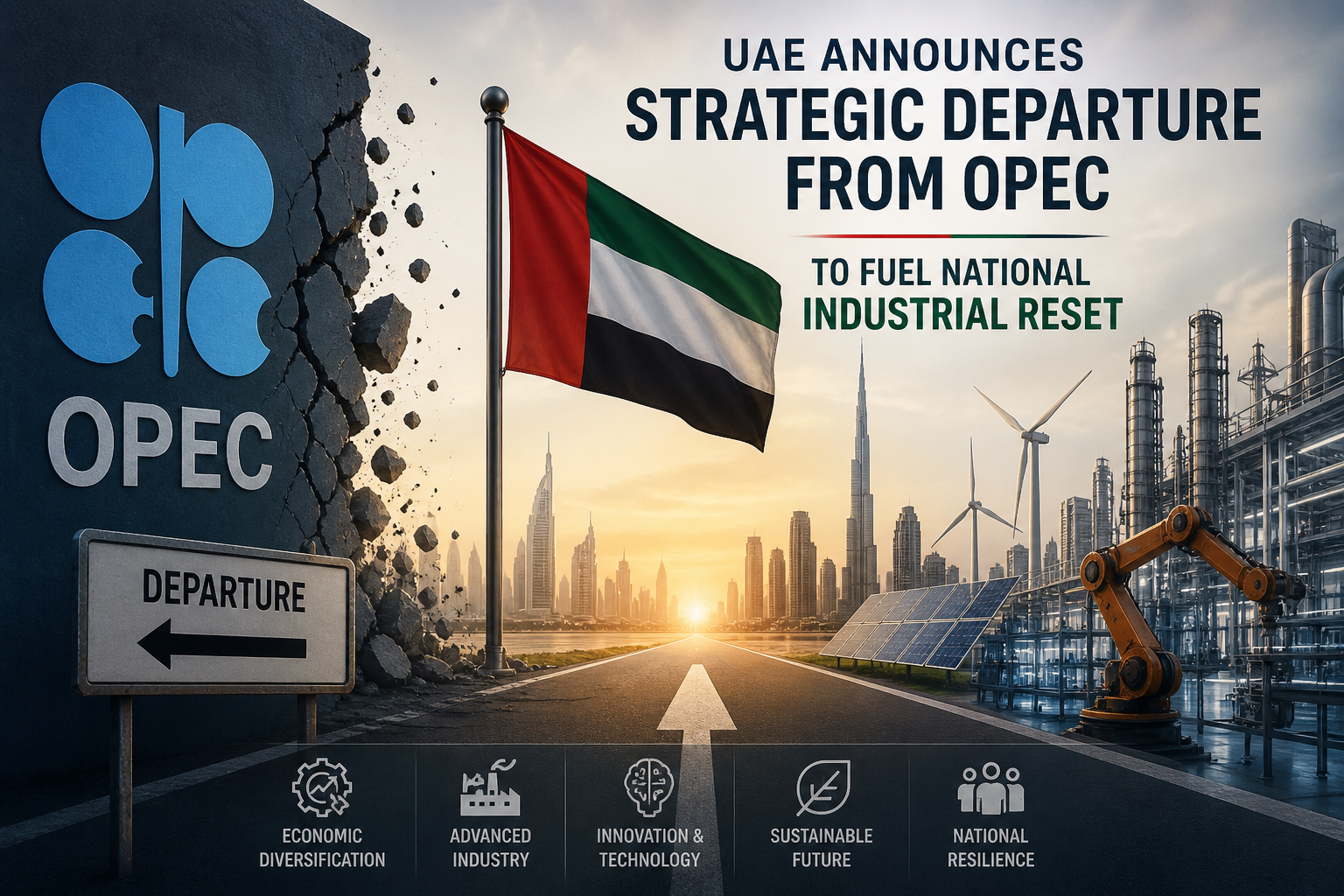
In a landmark move that signals a new era for the Middle Eastern economic landscape, the UAE has officially announced its departure from the Organization of the Petroleum Exporting Countries (OPEC). The decision, described by leadership as a “strategic repositioning,” aims to align the nation’s energy resources more closely with its ambitious industrial and technological transformation goals.
Dr. Sultan Al Jaber, Minister of Industry and Advanced Technology and Managing Director of ADNOC, detailed the shift during the “Make it in the Emirates” Forum. He framed the exit as a vital step in the UAE’s wider economic reset, moving the nation from a traditional resource exporter to a global industrial powerhouse.
Table of Contents
Prioritizing Production Sovereignty
The decision marks the end of the UAE’s long-standing adherence to the production quotas set by the OPEC+ alliance. For years, the UAE has aggressively expanded its production infrastructure, investing billions to reach a capacity of 5 million barrels per day (mbpd). By exiting the bloc, the nation gains full sovereignty over its output.
This autonomy allows the UAE to leverage its maximum capacity to fund large-scale domestic projects rather than keeping valuable infrastructure idle to maintain global price stability. “Our transition is rooted in the necessity of flexibility,” Dr. Al Jaber noted. “To drive the next phase of our industrial roadmap, we must ensure our primary resources are fully integrated with our national vision.”
Fueling the “Make it in the Emirates” Vision
A central pillar of this exit is the acceleration of the “Make it in the Emirates” initiative. The government intends to redirect the increased energy revenues toward high-growth sectors that will define the post-oil economy:
- Advanced Manufacturing: Scaling up the production of specialized exports, which have already seen a significant rise to Dh262 billion in recent years.
- Artificial Intelligence and Tech: Integrating AI into the industrial base to enhance operational efficiency, predictive maintenance, and global competitiveness.
- Supply Chain Resilience: Reducing dependence on global imports by fostering a robust domestic manufacturing ecosystem, particularly in chemicals, metals, and pharmaceuticals.
A Focus on Regional Stability and DDI
Beyond energy production, the announcement underscored the UAE’s commitment to regional economic security and the protection of trade routes. Dr. Al Jaber emphasized that the freedom of navigation in the Strait of Hormuz remains a “red line,” given its critical role in global trade and energy security.
Furthermore, the government is calling for a surge in Direct Domestic Investment (DDI). By encouraging local sovereign wealth funds and private entities to prioritize the UAE’s industrial sector, the leadership aims to build a self-sustaining economy that can thrive independently of global oil market volatility.
The 2030 Roadmap
While the move marks a departure from decades of energy policy, officials insist it is an evolution rather than a retreat. By decoupling from international production mandates, the UAE is positioning itself as a global hub for industry and innovation.
The strategy ensures that its natural resources serve as the primary engine for a technology-driven future, supporting the Operation 300bn strategy to raise the industrial sector’s contribution to the GDP to Dh300 billion by 2031.
Industry analysts suggest that this “UAE-first” energy strategy could set a precedent for other resource-rich nations looking to navigate the complexities of the global energy transition while maintaining aggressive domestic economic growth.
