

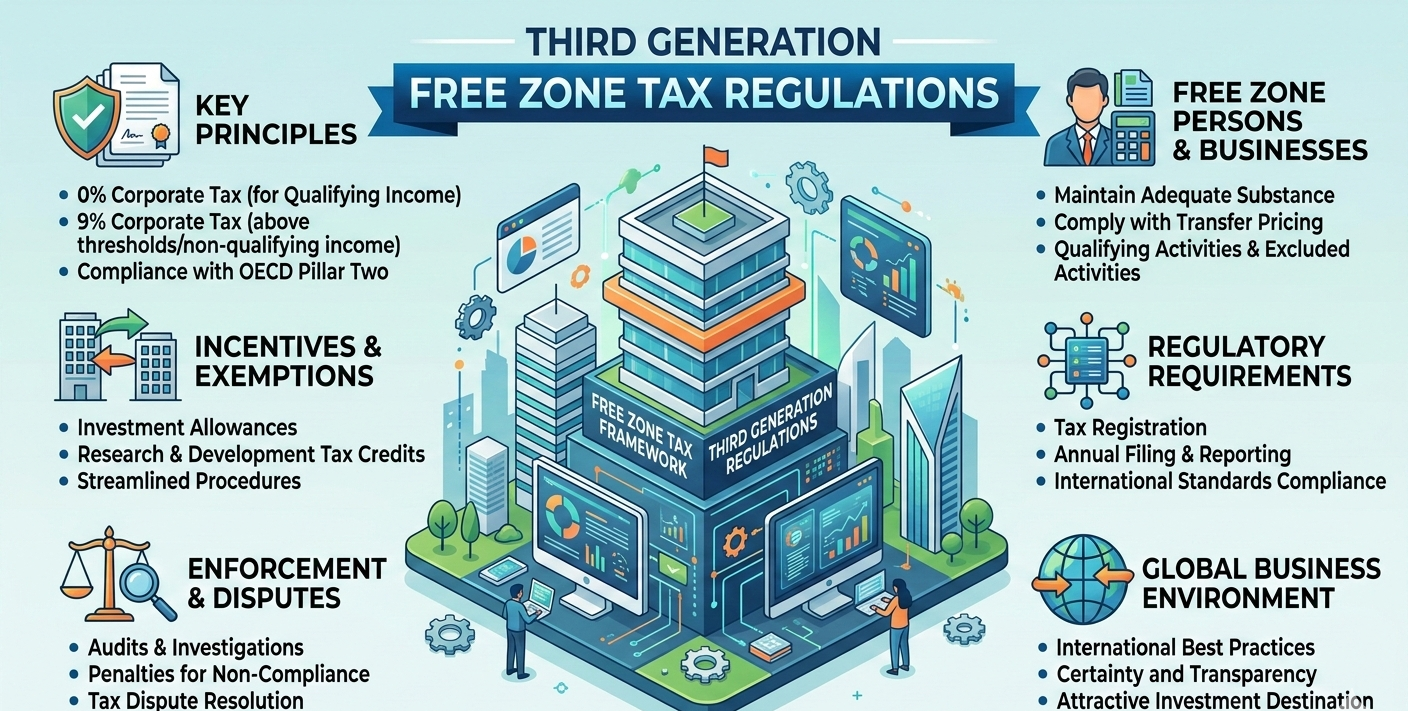
The UAE’s Free Zones have evolved significantly over the past three decades. What began as investment-driven economic clusters offering tax holidays and 100% foreign ownership has now transitioned into a regulated, transparency-based corporate tax framework.
With the introduction of Federal Decree-Law No. 47 of 2022 on the Taxation of Corporations and Businesses, the UAE entered what can be described as the “third generation” of Free Zone tax regulation, a regime balancing competitiveness with international compliance standards.
Table of Contents
Evolution of the UAE Free Zone Tax Model
First Generation: Tax Holiday Era
Historically, Free Zones offered:
- 0% corporate tax guarantees (often 15–50 years)
- Full foreign ownership
- Customs exemptions
- Simplified licensing
These incentives were primarily investment-driven and not aligned with global minimum tax or OECD transparency standards.
Second Generation: Substance and ESR Alignment
Following global pressure and the introduction of:
- Economic Substance Regulations (ESR)
- Ultimate Beneficial Ownership (UBO) rules
- AML frameworks
Free Zones shifted toward enhanced reporting and operational substance requirements.
However, there was still no federal Corporate Tax.
Third Generation: Corporate Tax with Conditional 0%
With Corporate Tax effective for financial years starting on or after 1 June 2023, Free Zone entities are now subject to a structured regime under Article 18 of the Corporate Tax Law.
Free Zone companies may benefit from a 0% Corporate Tax rate, but only if they qualify as a:
Qualifying Free Zone Person (QFZP)
This marks a fundamental shift: 0% is no longer automatic, it is conditional.
Qualifying Free Zone Person (QFZP): Core Requirements
To benefit from the 0% rate on qualifying income, a Free Zone entity must:
- Maintain adequate substance in the UAE
- Derive Qualifying Income
- Not elect to be subject to the standard 9% rate
- Comply with transfer pricing requirements
- Meet de minimis thresholds
- Prepare audited financial statements
Failure to meet any condition may result in loss of QFZP status.
Understanding Qualifying Income
Qualifying Income generally includes:
- Income from transactions with other Free Zone Persons
- Income from transactions with mainland businesses (for qualifying activities only)
- Income from certain regulated financial and distribution activities
However, income derived from mainland individuals is generally subject to 9% Corporate Tax.
Cabinet Decisions and Ministerial Decisions define:
- Qualifying Activities
- Excluded Activities
- De minimis thresholds
This introduces operational complexity that did not exist in earlier Free Zone models.
Substance Requirements: Beyond Physical Presence
The third-generation model emphasises real economic activity.
Adequate substance requires:
- Qualified employees
- Physical assets
- Operational expenditure
- Core income-generating activities performed in the UAE
This is closely aligned with OECD standards and Pillar Two developments.
Free Zone “brass plate” structures are no longer sustainable.
De Minimis Rule and Risk Exposure
A QFZP may earn limited non-qualifying income within a prescribed threshold (de minimis rule).
Exceeding the threshold may result in:
- Loss of 0% rate
- Taxation at 9% on full taxable income
- Possible multi-year disqualification
This makes revenue monitoring and classification critical.
Transfer Pricing and Documentation
Free Zone entities are not exempt from:
- Arm’s length principle
- Related-party disclosure requirements
- Transfer pricing documentation
Groups must ensure that pricing between:
- Free Zone entities
- Mainland entities
- Foreign affiliates
meets OECD-aligned standards.
The third-generation regime integrates Free Zones fully into the international tax compliance framework.
Interaction with Global Minimum Tax (Pillar Two)
Multinational groups with global revenues above EUR 750 million must assess:
- Whether 0% Free Zone income creates top-up tax exposure
- Interaction with Income Inclusion Rule (IIR)
- Impact on group effective tax rate
The UAE’s competitive 0% model must now be evaluated within global minimum tax calculations.
Regulatory Enforcement and Monitoring
In 2026 and beyond, enforcement focus is expected to increase through:
- Data exchange between FTA and Free Zone authorities
- Audited financial statement reviews
- Transfer pricing audits
- Substance verification
Loss of QFZP status may have significant financial consequences.
Strategic Considerations for Businesses
Reassess Free Zone Structures
Groups should review whether:
- Current activities qualify
- Mainland transactions create tax exposure
- De minimis thresholds are monitored monthly
Implement Revenue Segmentation Controls
Proper classification of:
- Qualifying vs non-qualifying income
- Mainland vs Free Zone revenue
is essential to preserve 0% eligibility.
Strengthen Governance Frameworks
Best practice includes:
- Board-level oversight
- Quarterly QFZP status reviews
- Integrated tax and finance reporting
Key Takeaways for Business Leaders
The third generation of UAE Free Zone tax regulation represents a structural shift from incentive-based tax holidays to a compliance-driven, internationally aligned regime.
The 0% Corporate Tax rate remains available but only for businesses that:
- Maintain adequate substance
- Derive qualifying income
- Comply with transfer pricing
- Monitor de minimis exposure
Free Zone structures can remain highly efficient, but they now require active governance, technical oversight, and continuous monitoring.
Businesses that treat QFZP status as automatic rather than conditional face significant tax and regulatory risk in the coming years.