

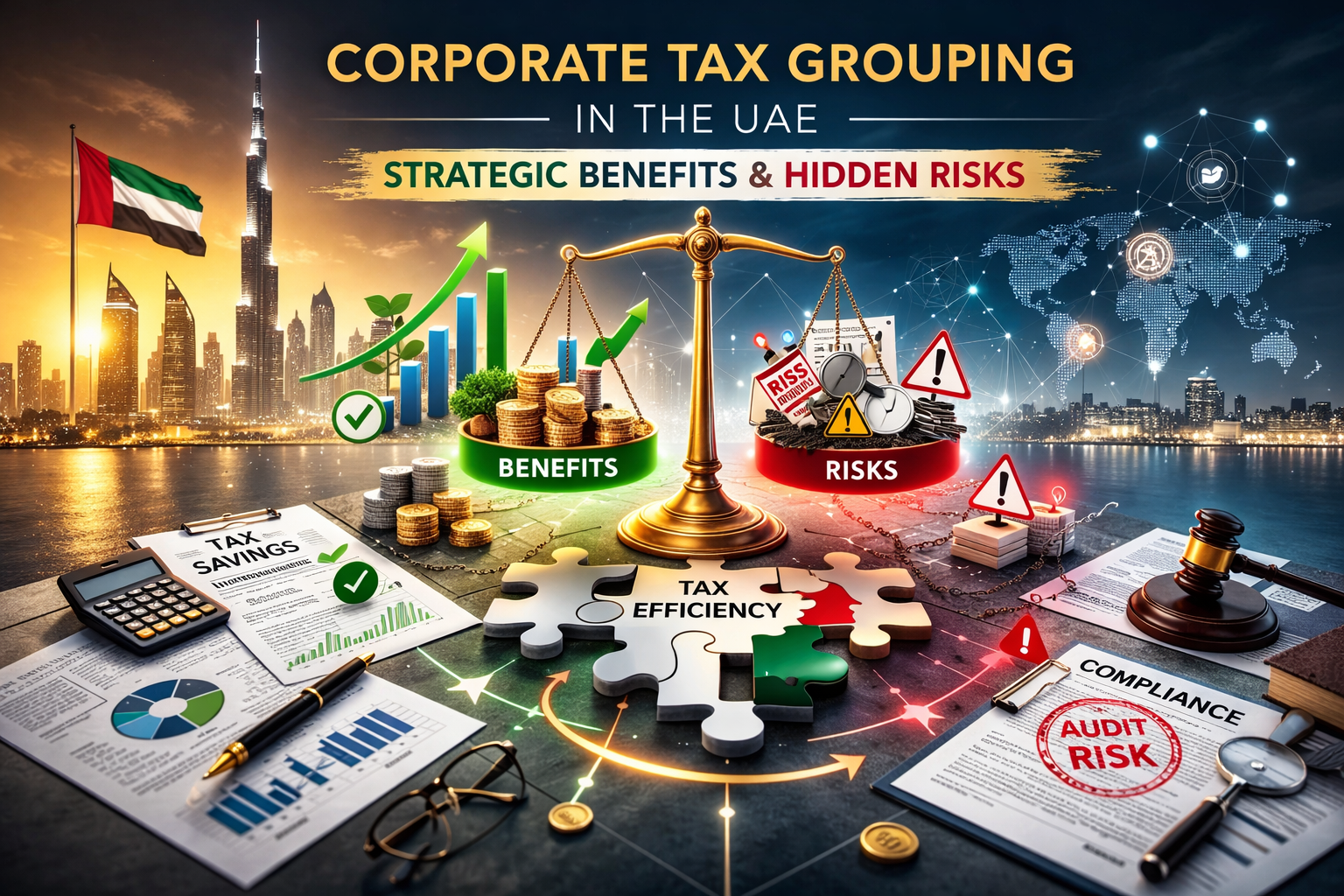
Corporate Tax Grouping under Federal Decree-Law No. 47 of 2022 offers significant structuring advantages for UAE-based groups. However, it also imposes joint liability, ownership rigidity, and compliance discipline that demand board-level oversight.
The decision to form a Tax Group is not merely administrative, it is a strategic election with direct implications for cash flow, risk exposure, and restructuring flexibility.
Table of Contents
Tax Groups Defined Under UAE Corporate Tax Law
Under Article 40, two or more UAE resident juridical persons may apply to form a Tax Group and be treated as a single Taxable Person.
Core Eligibility Conditions
To form a Tax Group:
- The parent company must own at least 95% of:
- Share capital
- Voting rights
- Rights to profits
- Rights to net assets
- Ownership may be direct or indirect.
- All members must:
- Be UAE resident juridical persons
- Have the same financial year
- Apply the same accounting standards (e.g., IFRS)
- The following cannot join:
- Exempt persons
- Qualifying Free Zone Persons (QFZPs)
- Non-resident entities without UAE permanent establishments
Once approved by the FTA:
- The parent becomes the representative member.
- A single consolidated Corporate Tax return is filed.
- The group is treated as one taxable person.
Qualifying Group Relief (Article 26): A Separate but Critical Tool
Qualifying Group Relief (QGR) is distinct from full Tax Grouping.
Under Article 26, tax-neutral transfers of capital assets or liabilities are permitted between entities that are at least 75% commonly owned, subject to conditions.
Key Characteristics
- Transfers occur at net book value.
- No gain or loss is recognized at the time of transfer.
- Election is required in the Corporate Tax return.
- Clawback applies if:
- The asset leaves the group within 2 years, or
- Ownership conditions are breached within 2 years.
Limitations
- Does not apply to trading stock.
- Does not apply to current assets or liabilities.
- Arm’s length principles still apply for other tax purposes.
QGR is particularly relevant for internal restructurings, M&A preparation, or operational realignments.
Strategic Benefits: Where Tax Grouping Creates Value
- Immediate Loss Offset Within the Group
One of the most important benefits is automatic offsetting of profits and losses across group members.
Without grouping:
- Tax losses can be carried forward.
- Utilization is limited to 75% of taxable income in a future period.
Within a Tax Group:
- Profits and losses are consolidated automatically.
- No separate loss transfer election is required.
- Losses reduce taxable income at group level.
For capital-intensive or growth-stage subsidiaries, this improves near-term cash flow.
- Elimination of Intra-Group Transactions for Tax Purposes
Transactions between group members are generally eliminated when computing consolidated taxable income.
This simplifies:
- Internal service recharges
- Intercompany financing
- Asset transfers
However, transfer pricing rules still apply to:
- Transactions with related parties outside the Tax Group
- Certain documentation requirements under UAE TP regulations
- Single Filing and Centralized Administration
The Tax Group files:
- One Corporate Tax return
- One consolidated tax payment
This centralizes compliance and can reduce internal reporting complexity across multiple entities.
While the law does not quantify administrative savings, operational simplification is often material for diversified groups.
- AED 375,000 Threshold Applied at Group Level
The 0% Corporate Tax rate applies to taxable income up to AED 375,000.
In a Tax Group:
- This threshold applies at consolidated level.
- It does not apply per entity.
For large groups, this may have limited impact; for smaller consolidated groups, it may be relevant.
Hidden Risks: Material Exposures That Must Be Understood
- Joint and Several Liability
All group members are jointly and severally liable for Corporate Tax obligations.
This means:
- If one entity fails to pay,
- The FTA may pursue recovery from any other group member.
For conglomerates with diverse risk profiles, this creates real exposure.
- Loss of Free Zone Benefits
Qualifying Free Zone Persons cannot join a Tax Group.
If a Free Zone entity joins and ceases to qualify as a QFZP:
- Its 0% qualifying income treatment may be lost.
- 9% Corporate Tax could apply.
Groups must model this carefully before electing consolidation.
- Ownership Rigidity
The 95% ownership threshold must be continuously maintained.
If ownership falls below 95%:
- The Tax Group may cease to exist.
- Transitional tax consequences may arise.
- Recalculations may be required.
This creates structuring constraints for joint ventures or partial divestments.
- Clawback Under Qualifying Group Relief
Under Article 26:
- If an asset transferred under QGR leaves the group within 2 years,
- The deferred gain becomes taxable.
This requires transaction monitoring and post-transfer governance.
- 5.Compliance Discipline Required
Tax Groups must maintain:
- Consolidation adjustments
- Elimination entries
- Supporting documentation
- Ownership evidence
- Consistent accounting standards
Failure to maintain documentation may increase audit exposure.
Deployment Roadmap for CFOs
Before electing Tax Group status:
Step 1: Ownership Review
Confirm 95% threshold across all legal and economic rights.
Step 2: Financial Modelling
Model:
- Profit/loss consolidation impact
- Loss carry forward utilization
- Free Zone implications
- Joint liability risk
Step 3: Governance Framework
Establish:
- Group tax policy
- Monthly consolidation processes
- Ownership monitoring controls
Step 4: FTA Application
Submit group formation application via the parent entity.
Critical Considerations for 2026 and Beyond
As the UAE Corporate Tax regime matures:
- FTA scrutiny of group elections is expected to increase.
- Transfer pricing documentation enforcement will strengthen.
- Audit focus may include ownership tests and elimination entries.
While no legislative amendment has changed the 9% headline rate, compliance expectations continue to evolve.
Executive Takeaway: A Strategic Election, not a Default Position
Corporate Tax Grouping in the UAE is a powerful strategic mechanism, but not a default election.
It delivers:
- Automatic loss pooling
- Consolidated reporting
- Simplified intra-group treatment
However, it also introduces:
- Joint and several liability
- Free Zone risks
- Ownership rigidity
- Clawback exposure
For multinational groups and large UAE enterprises, the decision must be driven by quantitative modelling and risk assessment not administrative convenience.