

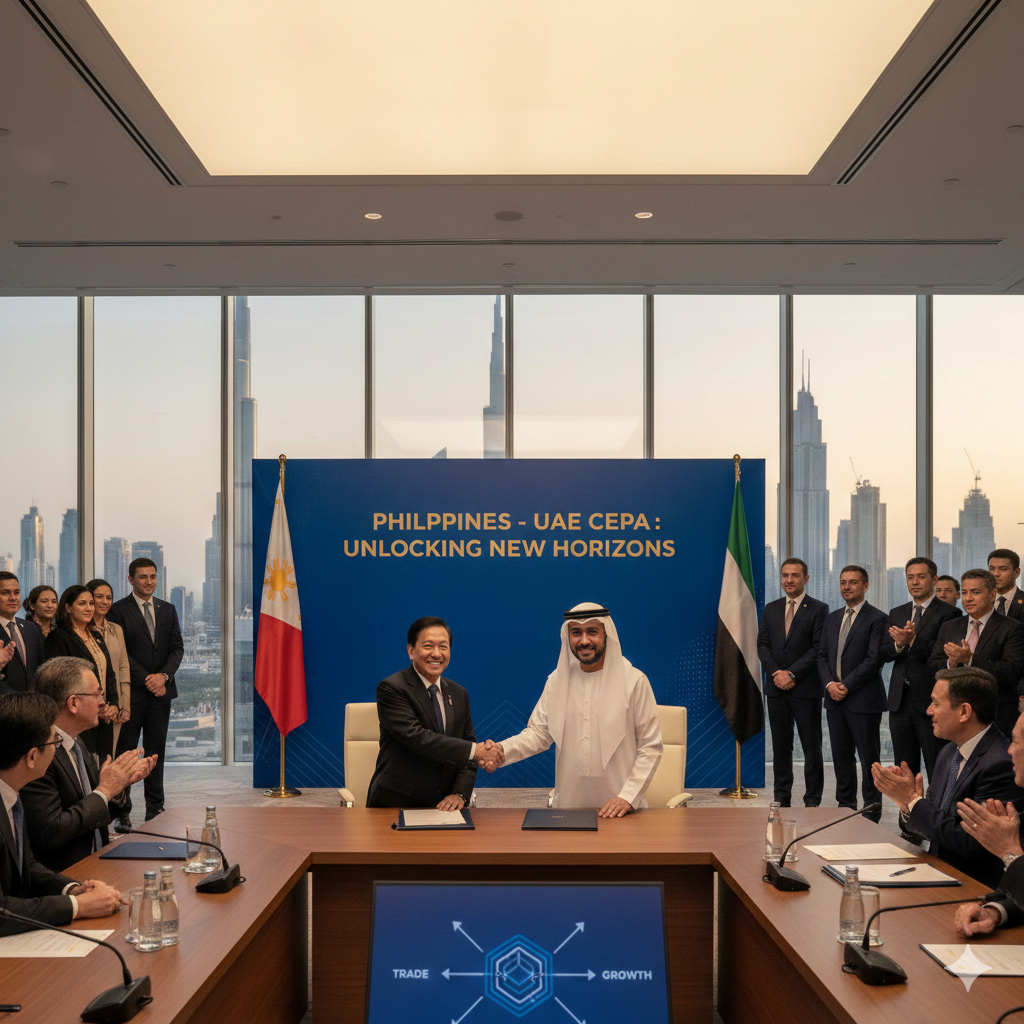
The Philippines is preparing to take a major step in strengthening its economic ties with the Middle East as President Ferdinand “Bongbong” Marcos Jr looks ahead to a Comprehensive Economic Partnership Agreement (CEPA) with the United Arab Emirates.
Speaking ahead of his official visit to the UAE, President Marcos Jr highlighted the Philippines’ strong growth potential and reform-driven investment environment, positioning the country as an increasingly attractive destination for global capital.
Table of Contents
Strengthening Bilateral Economic Ties
The proposed UAE–Philippines CEPA aims to deepen trade, investment, and economic cooperation between the two nations. If concluded, it would mark the Philippines’ first CEPA with a Middle East country, underlining the growing importance of the Gulf region in Manila’s global trade strategy.
CEPA agreements typically go beyond traditional free trade deals, covering areas such as:
- Tariff reductions and improved market access
- Investment protection and facilitation
- Cooperation in priority sectors including infrastructure, energy, logistics, and services
For businesses, such agreements often translate into lower trade barriers, greater certainty for investors, and expanded cross-border opportunities.
Reforms Driving Investor Confidence
President Marcos Jr pointed to several recent policy reforms that have strengthened the Philippines’ investment climate. These include:
- Allowing 99-year land leases to attract long-term foreign investors
- Reduced income tax rates and duties to improve business competitiveness
- An updated Public-Private Partnership (PPP) law, designed to fast-track large-scale infrastructure and development projects
These measures have already enabled the Philippines to secure multi-billion-dollar investments across key industries, reinforcing its ambition to move up the global economic rankings.
UAE’s Strategic Role
The UAE is one of the world’s most active investors and a major global trade hub, making it a strategic partner for the Philippines’ economic expansion plans. A CEPA would be expected to encourage:
- Increased UAE investment into Philippine infrastructure and energy projects
- Stronger trade flows in goods and services
- Job creation and long-term economic growth
The agreement also aligns with the UAE’s broader strategy of expanding its CEPA network to diversify trade partnerships and strengthen supply chains across Asia and beyond.
President Marcos Jr is expected to witness key developments related to the CEPA during his visit to Abu Dhabi. The discussions build on long-standing diplomatic relations between the two countries, which marked 50 years in 2024.
As negotiations progress, the proposed UAE–Philippines CEPA is widely seen as a win-win framework opening new markets for businesses, boosting investor confidence, and laying the foundation for deeper economic cooperation between Southeast Asia and the Middle East.
