

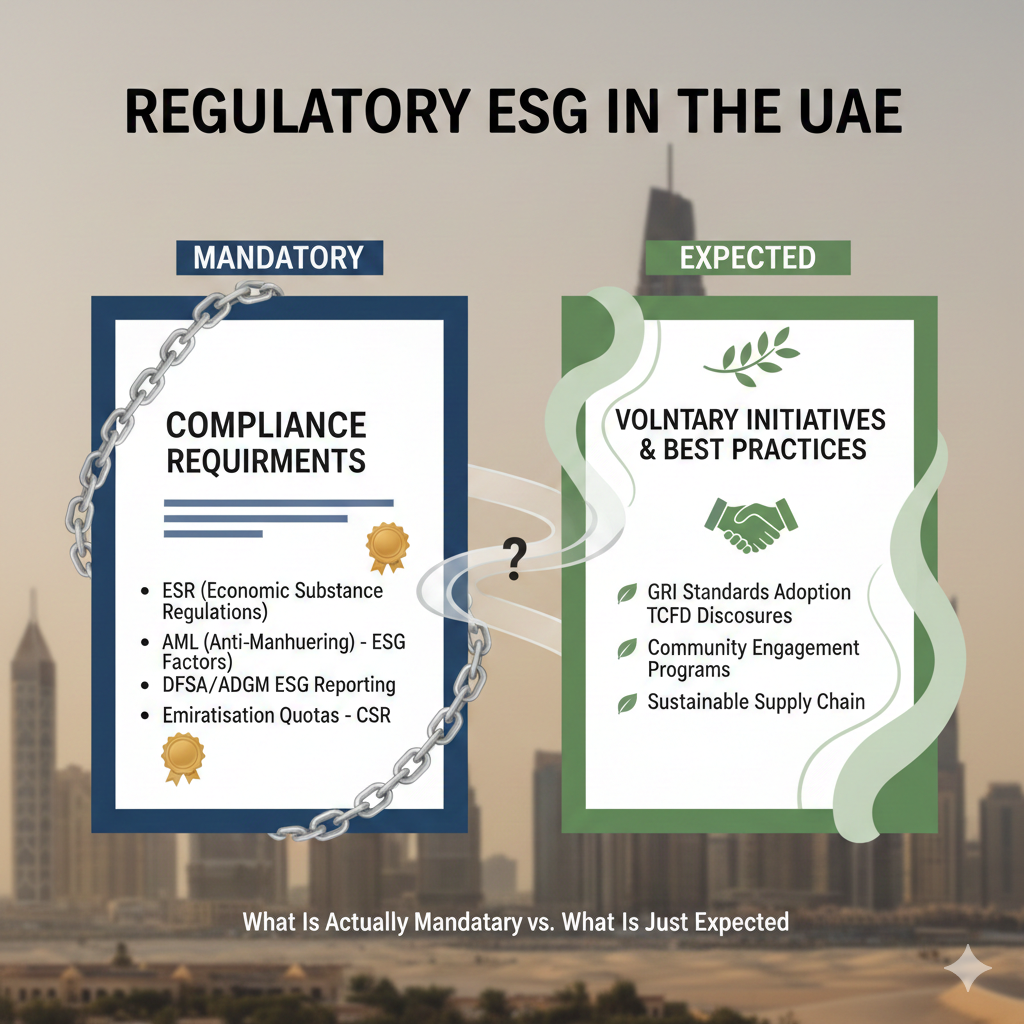
Understand which ESG rules can trigger fines, licence risk and enforcement — and which exist only through banks, investors and future listing expectations for private companies, family-owned groups and pre-IPO businesses
Table of Contents
Why ESG Feels Confusing—and Why That Is Rational
For many private companies in the UAE, ESG and sustainability requirements feel unclear, inconsistent, and often exaggerated. Business leaders are frequently told they must comply with ESG standards—yet struggle to identify:
- Which requirements are actually mandatory
- Which regulator can truly penalise them
- And which expectations are merely anticipatory or commercial
This confusion is not accidental. ESG is not governed by a single authority. Instead, it sits at the intersection of regulation, enforcement reality, financing expectations and future capital market access.
The real risk for businesses today is not non-compliance alone—it is misallocation of effort:
- Over-reporting where it adds no value, or
- Under-preparing where exposure is real and enforceable
This article clarifies what ESG means from a regulatory standpoint in the UAE, separating what is mandatory, what is indirectly enforced, and what is simply expected in anticipation of future scrutiny.
Listed vs Private Companies: The First Distinction That Matters
The most common ESG misunderstanding in the UAE is treating listed-company ESG requirements as if they apply equally to all businesses.
The regulatory reality is simpler:
- Private companies are not currently required to publish ESG or sustainability reports under stock exchange rules
However, this does not mean ESG is irrelevant for private businesses. The distinction is not between applicable and non-applicable, but between:
- Direct statutory obligation, and
- Indirect regulatory and commercial consequence
This distinction becomes critical in three situations:
- Pre-IPO preparation
- Regulatory licensing and renewals
- Capital raising and institutional financing
Stock Exchange & Capital Market Expectations: Indirect but Powerful
While ADX and DFM ESG requirements apply formally to listed entities, they play a decisive indirect role for private companies that are:
- Planning an IPO
- Considering strategic investors
- Preparing for eventual exit to public markets
What regulators focus on at pre-IPO stage is not “ESG reporting”. Instead, they focus on:
- Board oversight and governance structures
- Risk identification and control frameworks
- Environmental and social risk awareness
- Consistency between stated policies and actual practices
ESG gaps at this stage rarely result in outright rejection—but they delay approvals, increase regulatory questioning, and weaken investor confidence.
In practical terms: ESG is not a listing requirement problem—it is a readiness and credibility problem.
Central Bank of the UAE (CBUAE): No Direct Authority, Significant Financial Impact
One of the most misunderstood aspects of ESG in the UAE is the role of the Central Bank. The CBUAE does not regulate corporates directly. It regulates banks and financial institutions.
However, banks are now expected to:
- Integrate climate and environmental risk into credit assessment
- Evaluate governance quality and control environments
- Consider sustainability risks over the life of a loan
This expectation arises from the CBUAE’s supervisory guidance on climate-related and environmental financial risks.
What This Means for Businesses
ESG expectations enter corporate life through financing, not regulation. Banks increasingly request:
- ESG policies and governance frameworks
- Environmental risk assessments
- Evidence of compliance with applicable laws
- Board oversight and accountability structures
This is not about virtue signalling. It is about credit risk.
From a bank’s perspective, weak governance and unmanaged environmental risk increase default probability over time. As a result, ESG documentation now influences:
- Loan approvals
- Covenant structuring
- Pricing discussions
- Refinancing outcomes
Environmental Regulators: Where ESG Is Already Enforceable
Unlike capital markets or banking guidance, environmental regulation in the UAE is already enforceable.
Authorities such as The Ministry of Climate Change & Environment (MoCCAE), Emirate-level environmental regulators, Sector-specific regulators (energy, industrial, logistics, construction) have clear powers under federal and emirate-level laws to impose:
- Fines and penalties
- Licence suspensions
- Remediation obligations
- Retrospective liability
Recent climate-focused legislation further strengthens enforcement and disclosure expectations, particularly for high-impact sectors.
Where Businesses Get Exposed
Most environmental breaches are not due to intentional non-compliance, but due to:
- Fragmented responsibility
- Poor documentation
- No consolidated risk register
- Weak board-level oversight
ESG does not create new environmental obligations. It connects existing ones, making failures more visible and more defensible for enforcement.
Labour, Corporate & Economic Authorities: ESG as Visibility, Not New Law
Workforce welfare, health and safety, and corporate governance obligations already exist under UAE law, including labour and commercial company regulations.
What ESG changes is visibility and comparability. Regulators increasingly expect:
- Documented policies
- Clear accountability
- Evidence of implementation
From a regulatory standpoint, ESG is not about creating new offences—it is about demonstrating control.
What Regulators Actually Care About (and What They Do Not)
Regulators care about:
- Compliance with existing laws
- Governance and accountability
- Evidence, not narratives
- Consistency between policy and practice
Regulators do not care about:
- Marketing-led sustainability stories
- Generic ESG reports copied from templates
- Claims that cannot be substantiated
This distinction is critical to avoiding greenwashing risk, which is increasingly scrutinised under consumer protection and financial market integrity principles⁶.
The Real Question Business Leaders Should Ask
The right question is not: “Do we need an ESG report?”
It is: “Where are we exposed today, and where will scrutiny increase tomorrow?”
Right-Sized Compliance: A Practical Way Forward
Effective ESG management for private companies is not about over-engineering. It is about:
- Understanding what is mandatory
- Anticipating what is commercially expected
- Avoiding unnecessary reporting
- Preparing documentation that is regulator-credible, bank-ready and investor-defensible
Our Advisory Perspective
We help business leaders manage sustainability and governance where it actually matters:
- Regulation and enforcement
- Financing and cost of capital
- Transactions, valuation and exit outcomes
Our approach focuses on:
- Applicability assessment
- Regulatory gap analysis
- Governance and ESG framework design
- Audit-ready documentation
Our guiding principle:
Right-sized compliance: enough to satisfy regulators and lenders—without over-engineering or greenwashing.
Closing Thought
For private companies in the UAE, ESG is not a reporting exercise. It is a risk management and value protection discipline.
Understanding what is mandatory versus what is merely expected is the first step toward using ESG strategically—rather than reacting to it defensively.

Ajay is an experienced accounting professional known for his precision and client-focused approach. He brings deep expertise in bookkeeping, financial reporting, and business advisory services, ensuring clients meet their financial goals.