

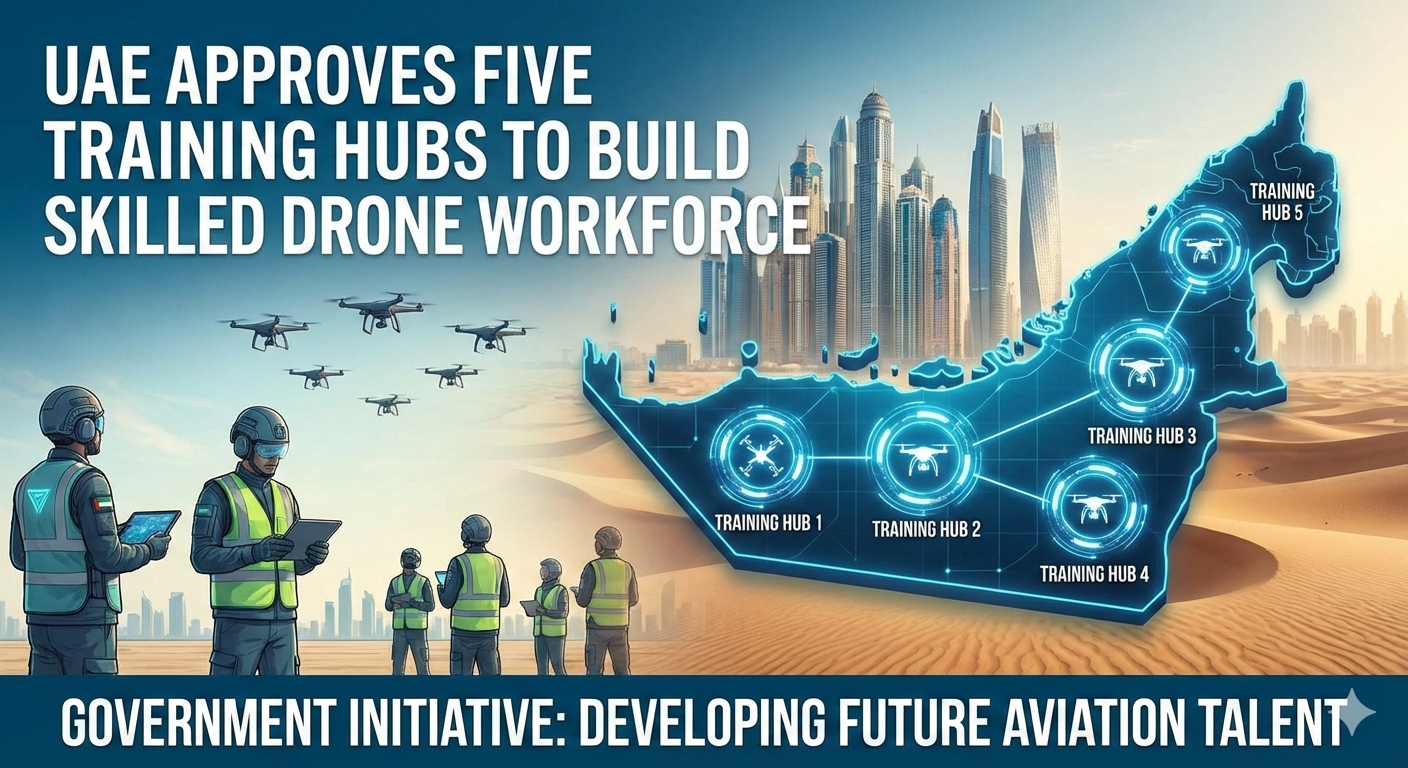
The United Arab Emirates has taken a significant step towards strengthening its commercial drone ecosystem by approving five specialised training hubs to certify drone operators locally. The move, led by the General Civil Aviation Authority (GCAA), is aimed at building a skilled domestic workforce and supporting the country’s rapidly expanding use of unmanned aerial systems (UAS) across key sectors.
Until now, many companies operating drones in the UAE faced limited local training options or were required to rely on overseas certification. The newly accredited centres now provide a regulator-approved pathway for training and certification within the country, making compliance easier and more cost-effective for businesses.
Table of Contents
Supporting Growth Across Industries
The approval of these training hubs comes as drone usage accelerates across industries such as logistics, infrastructure inspection, construction, oil and gas, security, surveying, media production and emergency services. Drones are also expected to play a growing role in last-mile delivery, smart city services and advanced air mobility initiatives.
By formalising training standards, the UAE aims to ensure that drone operations are conducted safely, professionally and in line with international aviation norms. Certified operators will be better equipped to manage flight operations, airspace coordination, safety compliance and data handling.
Accredited Training Centres
The five entities authorised by the GCAA to conduct drone training programmes are:
- Versa Aerospace
- Exponent e-Commerce DWC
- RCG for Wireless Aircraft Trading
- Emirates Falcons Aviation
- Falcon Eye Drones Planning & Aerial Photography Services
These centres will offer structured courses aligned with UAE aviation regulations, covering both technical flight skills and operational safety requirements.
Boost to Jobs and Skills Development
Beyond aviation, the initiative is expected to create new employment and career pathways for residents and graduates. Roles emerging from the drone economy include drone pilots, operations managers, safety and compliance officers, data analysts and maintenance specialists.
For businesses, the availability of locally trained professionals reduces dependency on foreign certification, shortens onboarding timelines and improves operational continuity.
Part of a Broader Aviation Strategy
The training hub approvals are aligned with the UAE’s broader aviation and airspace modernisation strategy. In recent years, authorities have refined drone regulations, introduced digital registration systems and developed integrated airspace management frameworks to support safe commercial operations.
As drone applications become more embedded in daily business and public services, regulated training and certification are increasingly seen as essential infrastructure rather than optional compliance measures.
A Competitive Advantage for the UAE
By enabling companies to train and certify drone operators domestically, the UAE is positioning itself as a regional hub for advanced drone operations and aerial innovation. The move enhances regulatory clarity, supports business growth and reinforces the country’s reputation as a forward-looking destination for aviation, logistics and technology-driven enterprises.
For companies planning to deploy drones at scale, the newly approved training hubs mark an important milestone in turning innovation into compliant, real-world operations.
