

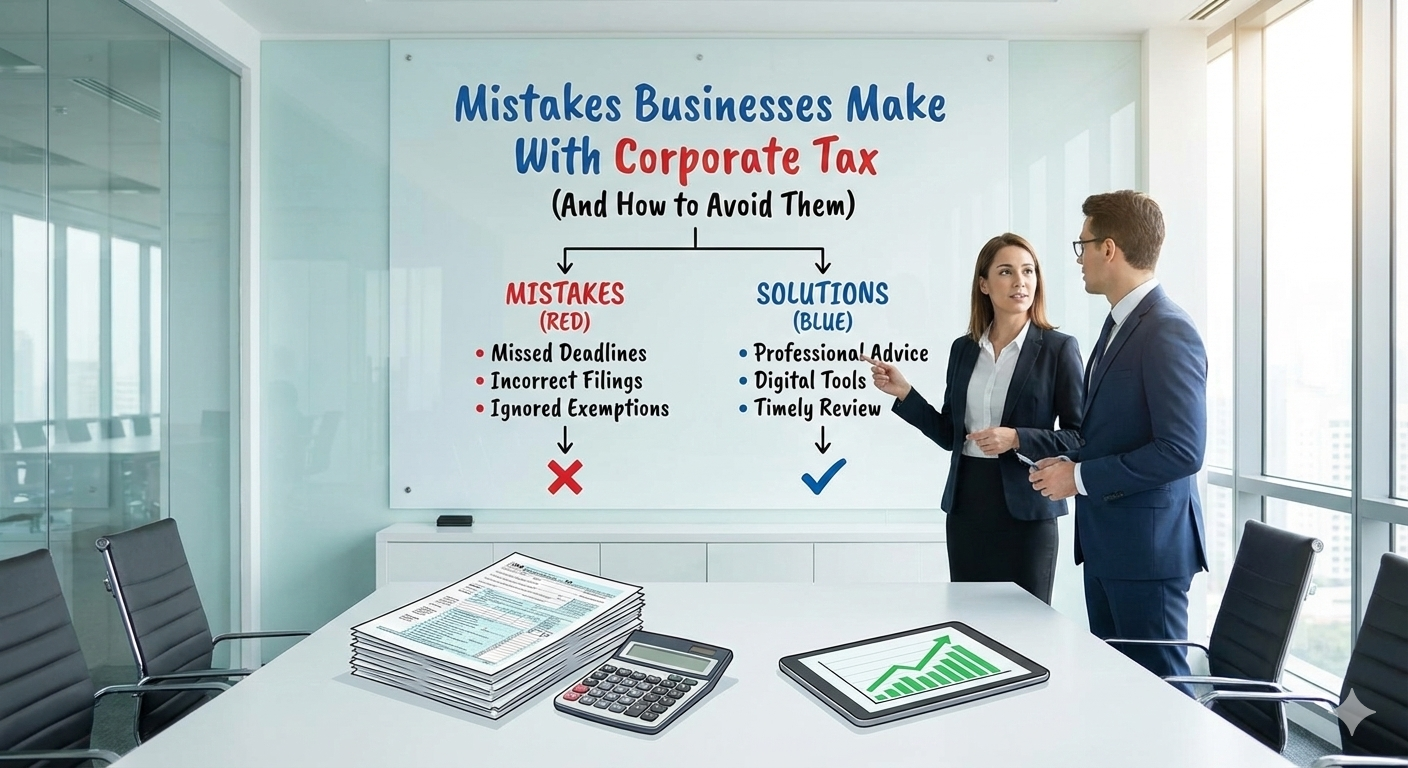
The introduction of corporate tax in the UAE has created new compliance responsibilities for businesses. While the regime is designed to remain business-friendly, misunderstanding or overlooking key obligations can lead to penalties, loss of tax benefits, and regulatory scrutiny.
This article highlights the most common corporate tax mistakes businesses make in the UAE and explains how to avoid them.
Table of Contents
Assuming 0% Corporate Tax Means No Compliance
One of the most frequent misconceptions is that businesses benefiting from a 0% corporate tax rate including free zone companies and small businesses do not need to register or file returns.
How to avoid it:
All taxable persons must register with the Federal Tax Authority (FTA) and file annual corporate tax returns, even if no tax is payable.
Missing Corporate Tax Registration Deadlines
Failure to register for corporate tax within the FTA-prescribed timelines can result in administrative penalties, regardless of actual tax liability.
How to avoid it:
Register early through the EmaraTax portal and monitor FTA announcements for deadline updates.
Incorrect Classification of Free Zone Income
Many free zone companies incorrectly assume that all income qualifies for 0% corporate tax. In reality, only qualifying income earned by a Qualifying Free Zone Person (QFZP) benefits from the 0% rate.
How to avoid it:
Segregate qualifying and non-qualifying income and ensure compliance with economic substance and transfer pricing requirements.
Misusing Small Business Relief
Some businesses incorrectly apply Small Business Relief (SBR) without meeting eligibility criteria, particularly the AED 3 million revenue threshold.
How to avoid it:
Confirm eligibility each tax period and formally elect SBR in the corporate tax return. Maintain supporting revenue documentation.
Poor Record-Keeping and Documentation
Inadequate accounting records can lead to incorrect tax calculations, delayed filings, and challenges during FTA audits.
How to avoid it:
Maintain accurate financial statements, tax computations, and supporting documentation for at least seven years, as required.
Ignoring Transfer Pricing Obligations
Businesses with related-party transactions often overlook transfer pricing documentation and disclosure requirements.
How to avoid it:
Assess related-party dealings annually and prepare transfer pricing documentation in line with OECD and UAE requirements.
Filing Late or Paying Corporate Tax After the Deadline
Late filing or delayed tax payments may attract fixed and variable penalties, even where the tax amount is small.
How to avoid it:
Track filing deadlines carefully corporate tax returns must be filed within 9 months of the financial year end and ensure timely payment.
Failing to SeekProfessional Advice
Corporate tax rules are evolving, and relying on assumptions or outdated guidance can expose businesses to risk.
How to avoid it:
Seek professional tax and legal advice to ensure ongoing compliance and optimal tax planning.
Key Takeaways
- Corporate tax compliance applies even at a 0% tax rate
- Registration and filing are mandatory
- Free zone and small business benefits require strict eligibility
- Accurate records and timely filings are essential
- Professional advice can prevent costly error
