

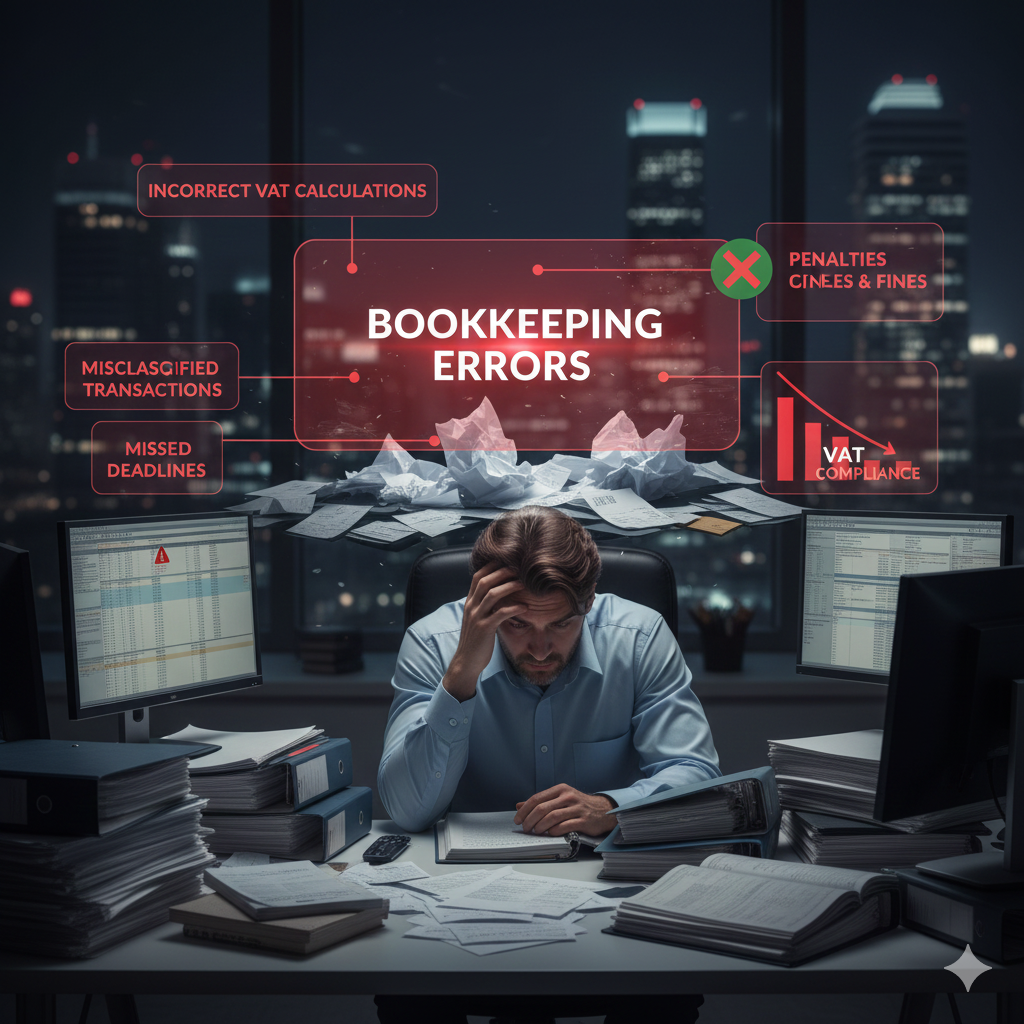
VAT compliance is not driven by tax law alone. It is driven by how accurately a business records and classifies its day-to-day transactions. Even companies with strong VAT knowledge can easily fall into non-compliance if their bookkeeping systems contain inconsistencies.
The Federal Tax Authority (FTA) relies on digital data from EmaraTax, customs integrations, and VAT returns to understand a company’s tax behaviour. If those numbers do not match the company’s internal ledgers, invoices, or documentation, the mismatch automatically becomes a compliance concern.
Bookkeeping errors are therefore not just accounting issues; they directly influence VAT liability, recoverability, penalties, refund approvals, and audit outcomes.
Table of Contents
Common UAE VAT Bookkeeping Errors and Why They Trigger FTA Audits
Incorrect VAT Coding: The Root Cause of Most Filing Errors
VAT coding is the mechanism through which accounting systems communicate with the VAT return. When VAT codes are incorrect, the integrity of every VAT report is compromised.
Incorrect coding typically appears as:
- Treating standard-rated supplies as zero-rated
- Confusing exempt and out-of-scope transactions
- Misapplying or omitting Reverse Charge Mechanism (RCM) codes
- Using custom tax codes that do not map correctly to VAT return boxes
- Incorrect classification of Designated Zone transactions
A single incorrect tax code repeated over multiple periods can distort VAT returns for several consecutive quarters, resulting in either overpaid VAT or under-declared VAT both of which require formal correction through FTA amendment and reassessment processes.
Missing or Non-Compliant Tax Invoices
UAE VAT is highly documentation driven. A tax invoice that fails to meet legal requirements is treated as invalid for VAT recovery purposes, regardless of whether VAT was actually paid.
Common issues include:
- Missing supplier TRN
- Incorrect invoice dates
- Wrong legal entity name
- Missing VAT amount or total values
- Inadequate description of goods or services
- Foreign currency invoices without AED equivalent
When invoices are non-compliant, input VAT becomes legally non-recoverable, and previously claimed VAT is often reversed during audits.
Poor Documentation for Zero-Rated and Export Transactions
Zero-rated supplies require more documentation, not less. Failure to maintain time-sensitive evidence frequently leads to reassessments.
Common gaps include:
- Missing customs export declarations
- Delivery notes without timestamps
- Courier or freight documents that do not align with invoice dates
- Lack of evidence that services were consumed outside the UAE
- No proof of foreign customer establishment or residence
Export documentation deficiencies are one of the top three causes of VAT reassessments in trading and logistics businesses in the UAE.
Where evidence is insufficient, FTA auditors can reclassify zero-rated supplies as standard-rated (5%), triggering retrospective VAT, penalties, and late payment interest.
Errors in Recording Imports and Customs Declarations
The FTA automatically receives import VAT and customs data through UAE customs systems. Bookkeeping systems must reconcile precisely with this information.
Frequent errors include:
- Using personal customs codes instead of the company’s TRN
- Missing import declarations
- Recording goods at incorrect customs values
- Failure to reconcile with EmaraTax import statements
- Omitting Designated Zone movements
Import VAT mismatches are among the most common reasons for FTA clarification notices, particularly for businesses that trade frequently across GCC borders.
When internal records do not match FTA data, discrepancies become immediately visible during VAT return processing and refund reviews.
Misclassification of Exempt and Zero-Rated Purchases
Different VAT treatments produce very different recovery rights.
Common consequences of misclassification include:
- Incorrectly reclaiming VAT on expenses linked to exempt supplies (which is disallowed)
- Failure to recover VAT on costs linked to zero-rated supplies (which is allowed)
- Distorted pricing and margin analysis
- Incorrect reporting in VAT return fields
Partial exemption errors are a leading cause of input VAT overclaims, particularly in real estate, financial services, and mixed-supply businesses.
Failure to Record Reverse Charge Mechanism (RCM) Transactions
RCM errors are among the most frequently audited high-risk areas.
Common failures include:
- Not identifying foreign supplier invoices
- Failing to record output VAT under RCM
- Incorrect or missing input VAT postings
- No reconciliation between RCM schedules and VAT return figures
- Incorrect distinction between imported goods and imported services
In technology-driven SMEs, uncaptured RCM transactions can represent 10%-25% of total VAT reporting exposure, particularly where foreign SaaS and marketing platforms are used.
Timing Differences and Incorrect Period Recognition
VAT liability is based on the date of supply, not the date of payment.
Errors arise when invoices are recorded:
- In the wrong tax period
- After VAT filing
- Without checking date-of-supply rules
- Based on cash movements rather than invoice dates
Period-cutoff errors are one of the most common causes of voluntary disclosures filed by UAE businesses after internal or external VAT reviews.
Inconsistent Reconciliations and Lack of Review Procedures
Reliable VAT compliance depends on regular reconciliations, not year-end clean-ups.
Weak reconciliation practices lead to:
- Unmatched input VAT
- Duplicate or missing invoices
- Unreconciled import VAT
- Differences between ledger and VAT return totals
Businesses that perform monthly VAT reconciliations experience significantly fewer FTA audit queries than businesses that reconcile only at the end of each quarter.
Bookkeeping Errors Create VAT Risks Long Before Filing Begins
VAT accuracy depends heavily on bookkeeping discipline. When accounting entries are clean, consistent, and properly documented, VAT filing becomes a simple administrative function. But when bookkeeping is rushed, inconsistent, or decentralised, VAT errors accumulate silently and only come to light during filing, refund applications, or audits.
The strength of VAT compliance in the UAE lies not in the VAT return itself, but in the quality of the financial records behind it. Businesses that invest in robust bookkeeping processes enjoy fewer audits, faster refunds, and a much lower risk of penalties.